
Choosing a Shingle Grade Around the Kansas City Metro
Homeowners across the Kansas City metro, from Riverside out to Overland Park and Independence, usually encounter the shingle grade question for the first time during a replacement quote. A roofing crew will mention three-tab, architectural, or designer shingles, and the terms can sound interchangeable if you haven't shopped for a roof before. They aren't. Each grade is built differently, performs differently in wind and hail, and carries a different price and appearance.
Missouri's mix of spring hail, summer heat, and winter freeze-thaw cycles puts real stress on a roof surface over time, which is part of why grade matters more here than in a milder climate. A shingle that's thin or single-layered shows wear faster under that kind of swing. Understanding the three grades before a roof replacement conversation helps you ask better questions and know what you're actually paying for.
Why Shingle Grade Changes How a Roof Performs
The core difference between grades comes down to layers and weight. A shingle with more asphalt and fiberglass packed into each piece sheds water longer, resists wind uplift better, and tends to look thicker and more textured from the ground. Manufacturers group shingles into three general tiers, and each one trades cost for durability and appearance in a different way.
Three-Tab Shingles: The Original Standard
Three-tab shingles are a single flat layer of asphalt with cutouts that create the look of three separate tabs across each strip. They're the lightest and least expensive option, which made them the industry standard for decades. Because they're one layer, they're also the thinnest and generally carry the lowest wind rating and shortest expected lifespan of the three grades.
You'll still find three-tab shingles on older homes that haven't been re-roofed, on some rental or investment properties, and occasionally on budget-conscious projects. They still meet code when installed correctly, but most manufacturers have scaled back three-tab production in favor of laminated shingles, and fewer product lines are available in this grade today than a generation ago.
Architectural and Designer Shingles: Built-Up Construction
Architectural shingles (also called laminated or dimensional shingles) are built from two layers of asphalt fused together, which creates a thicker product with visible shadow lines and a more textured, three-dimensional look. That extra layer adds weight and rigidity, and it's part of why architectural shingles generally carry higher wind ratings than three-tab and have become the default choice in new construction and most replacements.
Designer shingles push the same laminated construction further, using heavier materials and more elaborate shapes to mimic the look of slate, cedar shake, or other premium roofing materials. They sit at the top of the asphalt shingle market in both weight and price. For homeowners who want a specific architectural look without switching to a non-asphalt material, designer shingles are usually the product being discussed.
| Grade | Typical Construction | General Wind/Lifespan Range |
|---|---|---|
| Three-tab | Single layer, flat profile | Lower wind rating, shorter lifespan among the three grades |
| Architectural | Two-layer laminated, dimensional look | Higher wind rating, mid-to-long lifespan range |
| Designer | Heavier laminated, premium profile | Highest wind rating and longest lifespan range of the three |
What's Actually Layered Into a Shingle
Every asphalt shingle, regardless of grade, starts with a fiberglass mat coated in asphalt and topped with mineral granules that protect against UV exposure and give the shingle its color. The granules are what you see fading or washing into the gutters as a shingle ages, and granule loss is one of the clearest visible signs that a roof is approaching the end of its service life.
What changes between grades is how many of those asphalt-coated layers get fused together and how heavy the finished product is per bundle. More layers means more asphalt to resist water intrusion, more mass to resist wind uplift, and a thicker edge profile that's harder to lift during a storm. That's the physical reason architectural and designer shingles generally outperform three-tab in wind and hail exposure.
Step-by-step: How a Roofing Crew Evaluates Which Grade Fits Your Roof
A roofing contractor walks through a few practical factors before recommending a grade, balancing your budget against the roof's pitch, exposure, and how long you plan to stay in the home. Here's generally how that evaluation goes.
- Check current condition: The crew looks at the existing roof to see what grade is already installed and how it has held up to the local climate.
- Measure pitch and exposure: Steeper roofs and roofs with more direct sun and wind exposure often benefit from a heavier, higher-rated shingle.
- Discuss how long you'll stay: A longer-term homeowner may value the extended lifespan of a heavier grade more than someone planning to sell soon.
- Review manufacturer options: Available product lines vary, so the crew checks what's in stock and what warranty terms come with each option.
- Compare appearance preferences: Some homeowners want the flatter, uniform look of three-tab, while others prefer the dimensional shadow lines of architectural or designer shingles.
- Match any existing sections: If only part of a roof is being replaced, the crew usually matches the existing grade so the roof plane stays consistent.
- Finalize the recommendation: The crew presents the grade options with their general tradeoffs so you can make the final call on your roof.
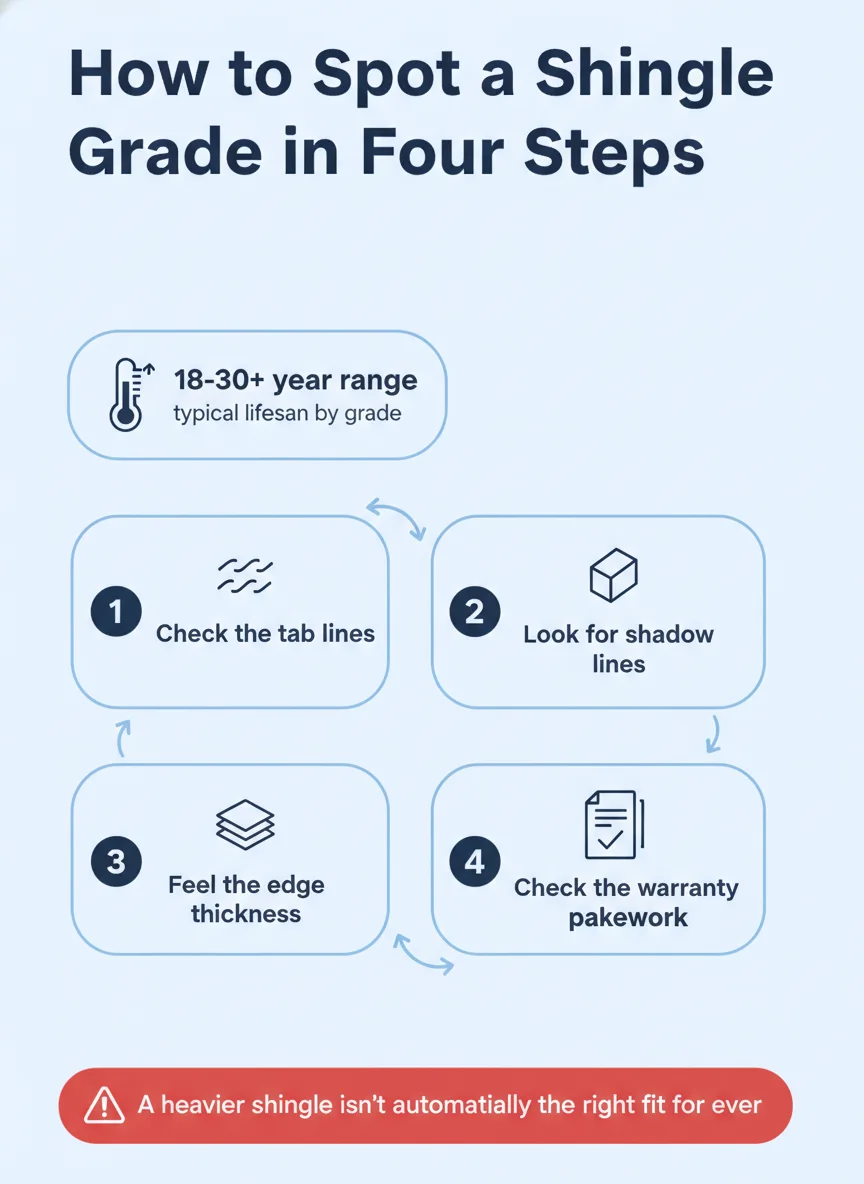
What Each Grade Looks Like on an Actual Roof
Spotting a Three-Tab Roof
From the ground or a drone photo, three-tab shingles show a flat, repeating pattern of evenly spaced cutout lines with no real shadow or texture. The surface looks uniform across the whole roof plane, almost like a grid. Up close, the shingle edge is noticeably thinner than a laminated product, and the tabs can curl or crack more visibly as the shingle ages due to the single-layer construction.
If your home was built or last re-roofed several decades ago and you've never had work done since, there's a reasonable chance three-tab shingles are still up there. Signs your roof needs attention can help you spot wear patterns that often show up earlier on this grade than on a laminated shingle.
Spotting an Architectural or Designer Roof
Architectural and designer shingles create visible depth and shadow across the roof plane, since the layered construction isn't flat the way three-tab is. From the street, the roof looks textured, almost like it has a subtle pattern rather than a uniform grid. Designer shingles push that further, often with irregular tab shapes meant to resemble slate or shake.
Up close, both grades feel noticeably thicker and heavier at the edge than three-tab. If you're not sure which one is on your home, a Roof Repair visit or a general inspection is usually enough for a roofing contractor to identify the grade on sight and tell you what condition it's in.
DIY vs Calling a Pro
Identifying the grade on your own roof from the ground, or even replacing a single shingle you can safely reach, is something many homeowners can handle with basic tools and caution. Spotting curling tabs, bald patches, or a flat versus textured look doesn't require special training, just a clear view and good light.
Anything involving the roof surface itself, climbing up, removing old shingles, or installing new ones, is where a licensed roofing contractor should take over. Proper installation includes underlayment, flashing details, and nailing patterns that affect the shingle's wind rating regardless of grade, and getting those wrong can void a manufacturer's warranty even on a premium product.
A professional eye also matters when you're trying to decide between grades for a full replacement, since the right call depends on your roof's pitch, your budget, and how long you plan to own the home. That's a conversation worth having before materials get ordered rather than after.
Getting the Right Grade for Your Home
Shingle grade isn't just a style choice, it's a construction difference that affects how your roof handles Missouri wind, hail, and sun over the years ahead. Three-tab still has a place for budget projects and like-for-like repairs, but architectural shingles have become the standard for most replacements, with designer shingles available for homeowners who want a premium look.
Knowing the difference going into a quote conversation means you can ask informed questions about wind rating, warranty terms, and appearance rather than taking a grade name at face value. Signature Roofing walks homeowners through these options as part of every replacement estimate.
Frequently asked questions
What's the difference between three-tab and architectural shingles?
Three-tab shingles are a single flat layer with cutouts that create three evenly sized tabs, while architectural shingles are made of two laminated layers that create a thicker, dimensional look. The extra layer in architectural shingles generally gives them a longer expected service life and a higher wind rating.
Are designer shingles worth the extra cost?
Designer shingles cost more because they use even heavier laminated construction and mimic the look of slate or shake, so the value depends on whether that appearance and added durability matter to you. For many homes, a standard architectural shingle delivers most of the same performance at a lower price point.
Can you mix shingle grades on the same roof?
Mixing grades on the same roof plane isn't recommended because the different thicknesses and layer counts create uneven transitions where water can collect. Most roofing crews will match the existing grade on a repair or move to a full replacement if a large section needs new shingles.
Do three-tab shingles still get installed on homes today?
Three-tab shingles are still manufactured and used, mostly on budget-driven projects, rental properties, and some older homes being repaired in kind. The large majority of replacements done in the last couple decades have shifted toward architectural shingles as the standard choice.
How can I tell what grade of shingle is on my roof right now?
Look up at the roof from the ground: three-tab shingles show flat, evenly spaced tab lines with no shadowing, while architectural shingles show a textured, dimensional surface with visible shadow lines. A close-up photo or a walk-through from a roofing contractor can confirm it if you're not sure.