
Why Missouri Roof Claims Get Denied or Underpaid
Spring and early summer storms roll through the Kansas City metro almost every year, and hail or straight-line wind can leave a roof with real, coverable damage. But getting a claim approved at the right amount isn't automatic. Insurance adjusters are working from their own inspection and their own read of your policy, and their numbers don't always match what a roofing contractor sees standing on the same shingles.
A denial letter or a lowball estimate can feel final, but it's usually just the opening position in a process that has room to move. Homeowners who understand why claims get denied or underpaid, and who know the specific steps available to them, end up in a much stronger spot than those who accept the first number and move on.
How Insurance Adjusters Evaluate Roof Damage
An adjuster's job is to determine whether the damage is storm-related and covered under your policy, and if so, how much it costs to fix. They walk the roof (or review drone and ground photos), note the pattern of hits or missing material, and compare it against what they'd expect from the storm date you're claiming. Disagreements usually show up in one of a few recurring spots.
Wear and Tear vs. Storm Damage
Most homeowners policies exclude damage from gradual aging, meaning an adjuster who sees granule loss, curling, or brittle shingles may attribute the whole problem to the roof simply being old rather than to the storm. This is the single most common reason a claim comes back denied. The roof may genuinely be near the end of its service life and still have real, storm-caused damage layered on top of that wear.
The distinction matters because it isn't always obvious from a quick walk-through. Hail impacts leave a different signature than years of sun exposure, and a contractor trained to spot that difference can document it in a way that supports a reopened claim. This is exactly the kind of review covered in meeting the insurance adjuster, where having the right photos ready changes the outcome.
Cosmetic Damage and Missed Slopes
Some policies include language limiting payout for damage the insurer considers purely cosmetic, meaning it doesn't affect function even if it's visible. Adjusters sometimes apply this label broadly, and it's worth pushing back on if the damage actually compromises the shingle's ability to shed water or hold granules.
Underpayment also happens when an adjuster's estimate only accounts for the slopes they could clearly see or access, leaving out a back slope or a section behind a chimney. A full measurement and a slope-by-slope photo record are the best way to catch this before a check is cut, and they're the same documentation worth requesting if a claim needs to be reopened.
| Situation | What It Means | Your Next Move |
|---|---|---|
| Claim denied outright | Insurer says damage isn't storm-related or isn't covered | Request a re-inspection with a contractor estimate in hand |
| Claim approved but underpaid | Insurer agrees there's damage but the dollar amount is short | Submit a supplement with documentation of the gap |
| Partial approval | Insurer covers one slope or one trade but not the full scope | Show why matching materials or code require more coverage |
| No response after appeal | Insurer and homeowner remain at an impasse | Consider the appraisal clause or a complaint to the state insurance department |
What a Claim Denial Letter Actually Says
Insurance denial letters are written in policy language, and the reason given is often narrower than it first appears. A letter that says damage is 'not storm-related' is different from one that says it's 'within normal wear parameters,' and each requires a different response. Reading the letter line by line, rather than just the summary at the top, tells you exactly what the insurer's position is and what evidence would challenge it.
The same goes for a low settlement. The line-item estimate attached to the payout shows what materials, labor rates, and quantities the insurer used to reach their number. Comparing that line by line against a contractor's own measurement and estimate is usually where the biggest gaps surface, whether it's a missed slope, an outdated labor rate, or a lower-grade material substitution.
Step-by-step: What to Do After a Denial or Low Payout
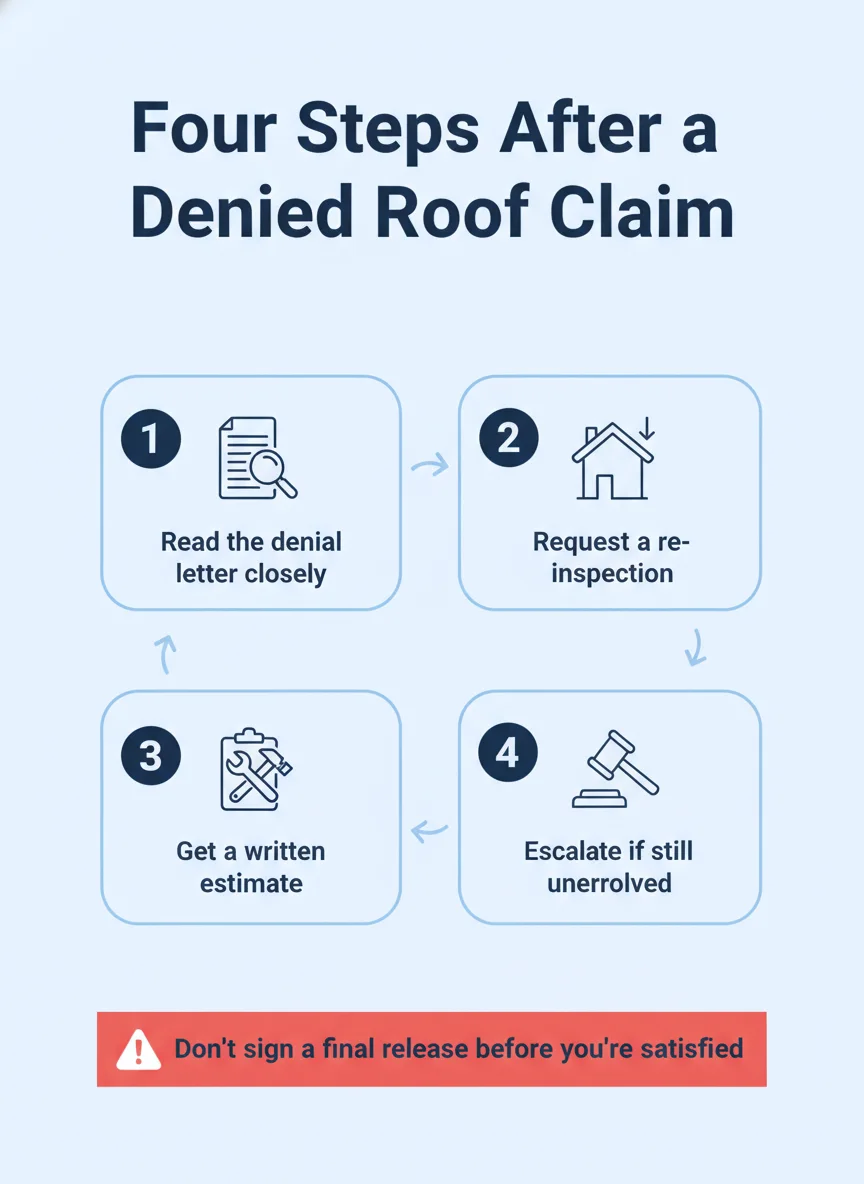
There's a fairly standard sequence homeowners in the metro follow when a claim comes back short. None of these steps require a lawyer to start, and most disputes resolve somewhere in the first few.
- Read the full letter: Identify the specific reason given for denial or the specific line items that were reduced, not just the summary total.
- Document everything yourself: Photograph every slope, penetration, and area of concern, and keep dated records of the storm and any prior repairs.
- Get a contractor estimate: A written, slope-by-slope estimate from a roofing contractor gives you a comparison point against the insurer's figures.
- Request a re-inspection: Ask the insurer to send an adjuster back out, ideally while your contractor is present to point out what was missed.
- Submit a supplement: If the gap is in pricing or scope rather than coverage, a formal supplement with documentation often resolves it without escalation.
- Invoke the appraisal clause: If you and the insurer still disagree on amount, most policies allow a formal appraisal process to settle the number.
- File with the state: If you believe the insurer acted in bad faith or ignored the process, Missouri homeowners can file a complaint with the state insurance department.
What You'll Typically Find: Denial, Underpayment, or Partial Approval
When the Insurer Says 'Wear and Tear'
If your denial hinges on age, the strongest response is photo documentation showing hail impact patterns, fresh granule loss in gutters, or displaced shingles that match the storm date, rather than a uniform pattern of aging across the whole roof. A roof can be old and still have a legitimate, separate storm claim layered on top.
It helps to know the house's roofing history, including when it was last replaced, since the year a house was built is not the same as the age of its current roof. A roof installed ten years after the home was built has a different story than the original, and insurers sometimes conflate the two.
When the Payout Doesn't Match the Damage
An underpaid claim often traces back to a measurement or pricing gap rather than a coverage dispute, which means it's usually resolved faster than an outright denial. A supplement request that lays out the specific missed items, with photos and measurements attached, is the standard path.
Matching requirements also come up here. If part of a roof is replaced but the material no longer matches the undamaged portion, some policies and some state rules address whether the insurer has to cover bringing the whole slope or roof into matching condition. That's worth raising specifically if your approved scope only covers a partial repair.
DIY vs. Calling a Pro: Who Handles What
Homeowners can absolutely read their own policy and denial letter carefully, and anyone can request a re-inspection or file a complaint with the state insurance department without hiring anyone first. Keeping your own photo and repair history is also something you don't need a professional for, and it strengthens every step that follows.
Where it gets harder to do solo is the technical documentation: measuring every slope, identifying hail versus wear patterns correctly, and writing an estimate in the same line-item format insurance companies use. That's the part a licensed roofing contractor is set up to do, and it's usually what turns a vague dispute into a specific, defensible supplement request.
A public adjuster is a separate option worth knowing about, since they represent your interests rather than the insurer's and can manage the whole negotiation for a share of the settlement. For a lot of homeowners, though, getting a solid contractor estimate and requesting a re-inspection resolves the dispute before it reaches that point.
Getting a Fair Outcome on Your Claim
A denial or a low payout is frustrating, especially after a storm has already put a homeowner through enough. But the process has real, specific mechanisms built in, from re-inspection requests to the appraisal clause to a state complaint, and homeowners who use them get better outcomes than those who stop at the first letter. Pairing good documentation with a contractor's storm and hail damage repair estimate is usually the fastest way to close the gap.
If you're dealing with a denial or a payout that doesn't match the damage on your roof, Signature Roofing can walk your roof, document the scope in writing, and help you understand what a fair settlement should look like before you sign anything.
Frequently asked questions
Why would an insurance company deny a roof claim?
Most denials come down to the adjuster classifying the damage as wear and tear, pre-existing, or cosmetic rather than storm-caused. Policies generally don't cover gradual deterioration, so if the roof was already near the end of its life, that becomes the insurer's main argument even when a storm made things worse.
What does it mean if my roof claim was underpaid?
An underpaid claim usually means the insurer's estimate missed damaged areas, used lower-cost materials or labor rates than it should have, or only approved a partial repair where a full slope or full roof replacement is warranted. A second, detailed estimate often reveals the gap.
Can I ask my insurance company to re-inspect my roof?
Yes, most homeowners policies allow you to request a re-inspection if you disagree with the adjuster's findings. Having your own contractor's written estimate and photos ready before that re-inspection makes the conversation far more productive.
What is the appraisal clause in a homeowners insurance policy?
The appraisal clause is a built-in dispute process most policies include for when you and the insurer can't agree on the amount of a loss, even if coverage itself isn't in question. Each side names an appraiser, the two appraisers pick an umpire, and the panel settles on a figure, which is often faster and less costly than a lawsuit.
Should I hire a public adjuster for a denied roof claim?
A public adjuster works for you instead of the insurance company and can be worth considering on a larger or more contested claim, though they typically take a share of the settlement. For straightforward disputes, a detailed contractor estimate and a re-inspection request resolve many cases without that extra step.