
Why Shingle Brand Comparisons Confuse Homeowners
Walk into any home improvement store or search for shingles online and you'll see a wall of brand names, each one claiming to be the strongest, the most weather-resistant, or the best looking. For a homeowner in the Kansas City metro trying to compare a quote from one roofer against another, that marketing noise makes it hard to tell what's actually different between products and what's just packaging.
The good news is that the real differences between major shingle manufacturers come down to a small handful of measurable things: wind rating, impact resistance, warranty structure, and algae resistance. Once you know what those terms mean, a spec sheet from one brand becomes easy to compare against another, and you can ask sharper questions when you're getting bids for a full roof replacement.
What Actually Separates One Shingle Brand From Another?
The short answer is manufacturing process, granule technology, and warranty backing. Most major brands, including GAF, Owens Corning, CertainTeed, Malarkey, and Tamko, make asphalt shingles from a similar base of fiberglass mat, asphalt, and mineral granules. The differences show up in how thick the mat is, how the sealant strip performs in wind, and how the company structures its warranty and certifies installers.
Wind and Impact Ratings
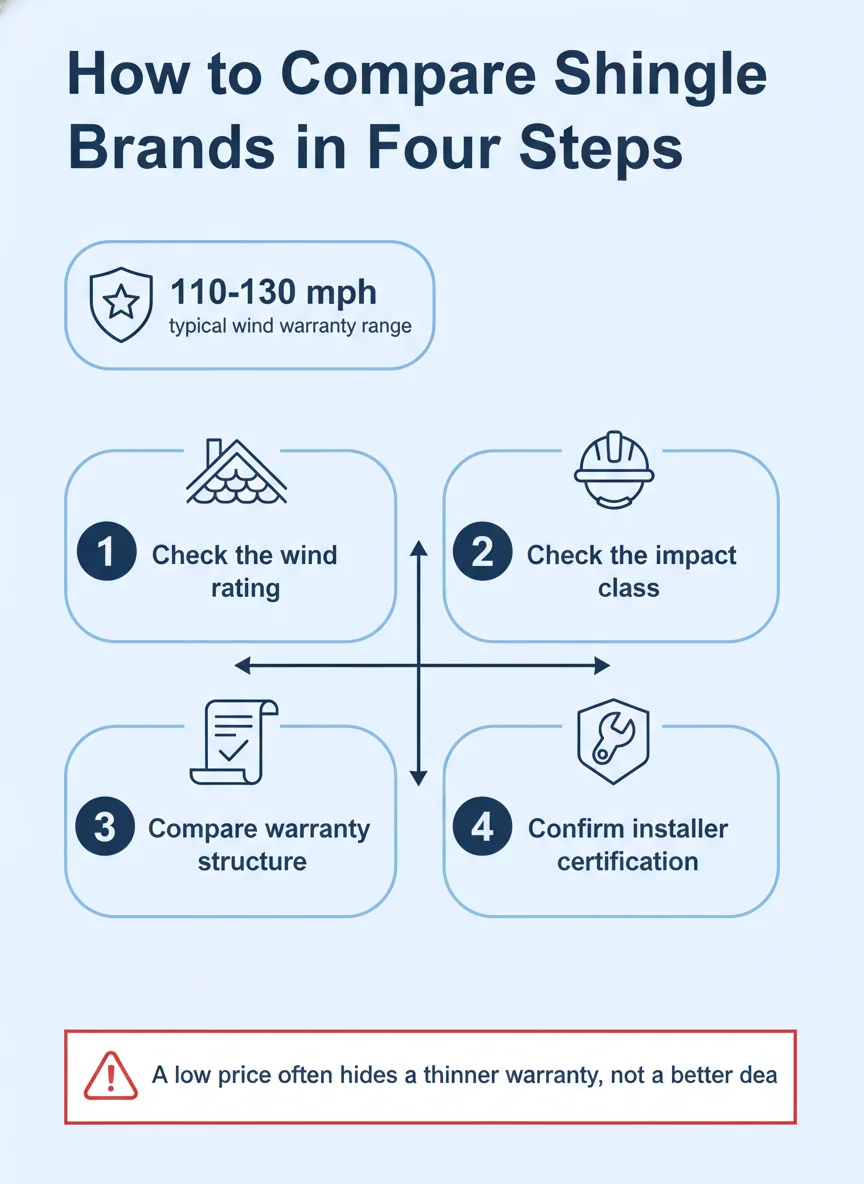
Wind ratings tell you the sustained wind speed a shingle is rated to handle when it's installed exactly to the manufacturer's spec, and most architectural shingle lines from major brands fall somewhere in the 110 to 130 mph range. Impact ratings use a separate scale, Class 1 through Class 4, that measures resistance to damage from falling debris and hail using a standardized steel ball drop test.
A Class 4 shingle isn't hail-proof, but it's built with a tougher mat or a modified asphalt layer that resists cracking better than a standard shingle. Not every brand offers a Class 4 option in every color and style, so if impact resistance matters to you, confirm the specific product line carries that rating rather than assuming the whole brand does.
Warranty Structure and Algae Resistance
Every major brand offers some version of a lifetime material warranty, but the coverage usually steps down over time and often separates material coverage from labor coverage. The strongest warranty tiers, the ones that cover both material and labor for an extended period, typically require the shingles to be installed by a contractor certified by that manufacturer.
Algae resistance is the other variable worth checking. Humid climates like Missouri's grow the blue-green algae that causes dark streaking on a roof, and most major brands now treat their granules with a copper or other algae-resistant compound. That resistance is usually warrantied separately, often for a shorter period than the main material warranty, so it's worth reading that line item specifically.
| What to Check | What It Tells You | Where to Find It |
|---|---|---|
| Wind warranty range | How the shingle performs under sustained high wind when installed to spec | Manufacturer spec sheet or product page |
| Impact class (1-4) | Resistance to cracking from hail or falling debris | Product label or manufacturer certification |
| Warranty labor coverage | Whether you're covered for installation cost, not just material, if a defect shows up | Written warranty document, not the sales brochure |
| Algae resistance term | How long the color-stability warranty against algae staining lasts | Separate warranty clause, often shorter than the main term |
How the Shingle Fits Into the Rest of the System
A shingle is one layer in a roofing system that includes underlayment, flashing, ventilation, and the deck underneath. Even the best-rated shingle on the market will underperform if the attic isn't ventilated properly or if the underlayment beneath it is low grade, because heat and moisture trapped under the shingle accelerate wear from below.
That's part of why manufacturer warranties increasingly require a full system, not just the shingle itself, to qualify for the strongest coverage tiers. When you're comparing brands, ask whether the warranty you're being quoted covers the shingle alone or the full system including underlayment and ventilation components.
Step-by-Step: Comparing Shingle Brands Before You Choose
Use this order of operations when you're looking at competing shingle options on a quote, whether you're comparing brands directly or comparing bids from different roofers who each use a different product line.
- Identify your climate priority: Decide whether wind, hail impact, or algae resistance matters most for your home's exposure and location.
- Compare wind ratings: Check the sustained wind speed rating for the specific product line, not just the brand name as a whole.
- Check impact class: Confirm whether a Class 4 impact-resistant version exists in the style and color you want.
- Read the warranty fine print: Look specifically for how long labor coverage lasts versus material-only coverage.
- Confirm installer certification: Ask whether your roofer is certified by the manufacturer, since the strongest warranty tiers usually require it.
- Factor in the full system: Check whether the warranty covers underlayment and ventilation components, not the shingle alone.
What You'll Notice Once You Start Comparing Spec Sheets
Once you line up two or three brands side by side, the differences get smaller than the marketing suggests. Most reputable manufacturers land in a similar range on wind rating and offer a Class 4 option somewhere in their lineup, so the gap often comes down to warranty structure and whether your roofer is certified to offer the top-tier backing.
When Brand Differences Matter Most
Brand differences matter most in two situations: homes in areas with frequent severe weather, where an impact-resistant class and strong wind rating earn their keep, and homes where resale value is a priority, where a transferable warranty gives the next buyer confidence. If your roof replacement is more about routine wear than storm exposure, the gap between top brands narrows further.
You can also learn about shingle grading separately from brand, since the terms three-tab, architectural, and designer describe shingle tier within any given manufacturer's lineup, more on that in our post on three-tab, architectural, and designer shingles.
When Installer Choice Matters More Than Brand
In almost every case, who installs the shingle matters more than which brand it is. Nail pattern, starter strip placement, and attic ventilation all affect how a shingle performs over its lifespan, and a poor install will undercut even a top-tier product's wind and warranty performance.
That's the reason manufacturer certifications exist in the first place: they verify that a contractor has been trained on that brand's specific installation requirements before the strongest warranty tiers kick in. A certification is worth asking about on any quote, regardless of which brand you end up choosing.
What a Homeowner Can Research vs. What a Roofer Should Verify
A homeowner can absolutely pull up a manufacturer's website and compare published wind ratings, impact classes, and warranty terms before ever calling a contractor. That research narrows the field and gives you specific questions to ask when bids start coming in, which saves time on both sides.
What a homeowner generally can't verify alone is whether a given roofer is actually certified to install a brand at the tier that unlocks the strongest warranty, or whether the ventilation and underlayment on your specific home meet that brand's system requirements. That verification needs a licensed roofer who works with the manufacturer directly.
It's also worth having a roofer walk your roof before you commit to a brand, since deck condition, pitch, and existing ventilation can all affect which products are even a good fit for your home. A quote that skips that step is skipping information you need to make a real comparison.
Bringing It Back to Your Home
Shingle brand comparisons matter less than the marketing suggests and more than ignoring them entirely. Knowing how to read a wind rating, an impact class, and a warranty's labor coverage puts you in a much stronger position whether you're comparing two brands or comparing two roofers' bids on the same brand, including homes across Overland Park and the rest of the metro.
Signature Roofing installs Owens Corning Duration shingles as an Owens Corning Preferred Contractor, and we're glad to walk through how that product's ratings and warranty compare to whatever else you're considering.
Frequently asked questions
Are expensive shingle brands actually better than cheaper ones?
Not always. A lot of the price gap comes from marketing and product tier (three-tab versus architectural versus designer) rather than a dramatic difference in the underlying asphalt. The things that actually matter are the wind rating, the impact rating, and whether the warranty is backed by a certified installation.
What does a shingle's wind rating actually mean?
It's the sustained wind speed the shingle is rated to withstand when installed according to the manufacturer's nailing pattern. Most major brands publish a range, often somewhere around 110 to 130 mph for their architectural lines, but the number only holds if the install meets the manufacturer's spec.
Is a lifetime shingle warranty really for life?
No, 'lifetime' almost always means the length of time the original owner lives in the home, and most warranties step down in coverage value over time. Read the fine print on labor coverage specifically, since material-only warranties leave you paying for the work.
Does algae resistance actually matter for a Missouri roof?
Yes, humid Midwest summers are exactly the conditions that grow the dark streaking algae causes, so a shingle with algae-resistant granules holds its color longer. It's a cosmetic issue rather than a structural one, but it affects curb appeal and resale.
Does the brand of shingle matter more than who installs it?
Installation quality generally matters more than brand, since even a premium shingle will fail early if it's nailed wrong or ventilation is off. That's part of why manufacturers tie their strongest warranties to certified installers rather than offering them on every job regardless of who does the work.