
A Small Repair, A Big Decision
Across the Kansas City metro, a single missing shingle or a small drip in the ceiling can feel like a job for whoever's available this weekend. A handyman is often cheaper by the hour and easier to schedule on short notice, so it's tempting to call the first number in your phone rather than a specialty contractor.
But a roof isn't a deck board or a loose cabinet hinge. It's a layered system of shingles, underlayment, flashing, and ventilation working together to keep water out of a house, and Missouri's mix of hard freezes, high humidity summers, and spring hail puts real stress on that system every year. Knowing which repairs are simple surface fixes and which ones touch that layered system is the difference between a job done once and a job done three times.
Why This Decision Matters More Than It Looks
The risk with a small roof repair isn't usually the repair itself, it's what's hiding underneath it. A missing shingle might expose nothing more than bare underlayment, or it might sit right next to a flashing seam that's already letting water in slowly. Someone without roofing-specific training can fix what they can see and miss what they can't.
What a licensed roofer brings to a small job
A roofer carries liability insurance, knows how to match shingle type and color so a patch doesn't stand out, and understands how flashing around chimneys, skylights, and vents is supposed to overlap and seal. That matters even on a repair that only touches a few square feet of roof, because flashing mistakes are one of the most common causes of leaks that return months later.
Working with a licensed roofer for a repair also typically keeps a workmanship or manufacturer warranty intact, since many warranties specify that repairs be performed by a certified installer. If your roof already carries a warranty, that's worth checking before anyone climbs a ladder.
Where a handyman is a reasonable call
Not every roof-adjacent task needs a roofer. Clearing debris off a low-slope roof, resealing an exposed nail head you can already see, or handling gutter cleaning are tasks a capable handyman can manage safely and affordably. These are maintenance items more than structural repairs, and they don't typically involve removing or replacing shingles.
The line gets blurry fast once a job involves climbing a steep pitch, removing multiple shingles, or working near a flashing detail. At that point the risk to the roof, and to whoever's on the ladder, goes up, and it's worth a second opinion from a roofing contractor before work starts.
| Task | Handyman | Licensed Roofer |
|---|---|---|
| Clearing debris or leaves off a roof | Usually fine | Not necessary |
| Resealing a visible exposed nail | Often fine | Fine, but a quick add-on to a roofer visit |
| Replacing a single easy-to-reach shingle | Workable for simple cases | Better match on color and fastening pattern |
| Flashing repair near a chimney or vent | Risk of recurring leaks | Trained for proper overlap and sealing |
| Multiple missing or damaged shingles | Beyond typical skill set | Standard repair scope |
What's Actually Going On Under a Small Repair
Underneath every shingle is underlayment, a water-resistant barrier that's the roof's backup line of defense if a shingle fails. Where two roof planes meet, or where the roof meets a chimney, wall, or vent pipe, flashing (strips of metal) directs water away from those seams. A repair that only replaces a shingle but ignores damaged flashing or torn underlayment hasn't actually fixed the leak, it's covered it up.
This is why a roofer will often pull back more material than a homeowner expects for what looks like a small job. Checking the decking and flashing underneath a damaged area isn't the contractor padding the job, it's standard practice for finding out whether the visible damage is the whole story or just the part that shows.
Step-by-Step: How to Decide Who to Call
Before you pick up the phone, walk through a short checklist. It won't replace a professional look, but it will tell you which direction to lean.
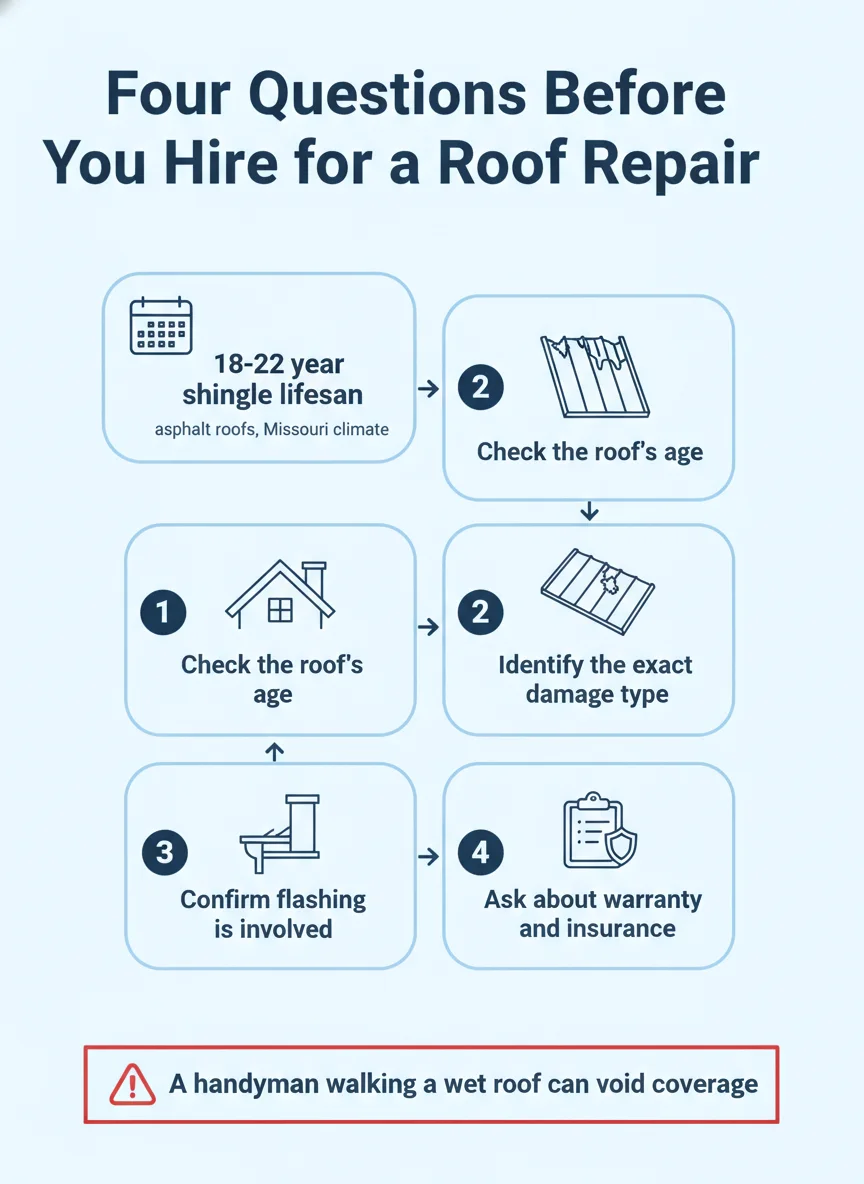
- Check the roof's age: Asphalt shingle roofs in Missouri typically last somewhere in the 18 to 22 year range. A repair on an older roof is more likely to reveal additional wear nearby.
- Look at the damage from the ground: Note whether it's a single isolated shingle or several in the same area. Multiple damaged shingles usually points toward something beyond a one-off fix.
- Note the location: Damage near a chimney, vent, skylight, or where two roof sections meet almost always involves flashing, not just shingles.
- Ask about licensing and insurance: A licensed roofer carries liability coverage for the work; many handymen do not carry roofing-specific insurance.
- Check your warranty terms: If your roof is under a manufacturer or workmanship warranty, confirm whether non-roofer repairs could affect that coverage.
- Get a second opinion if unsure: A quick look from a roofing contractor costs little and can confirm whether the fix is simple or more involved.
What You'll Usually Find Once Someone Takes a Closer Look
In a lot of cases, what looked like a simple missing shingle turns out to be exactly that, a simple missing shingle with no hidden damage underneath. In those cases a straightforward repair handles it and the roof is fine.
When it's genuinely minor
If the shingle blew off recently, the underlayment beneath it is intact, and there's no staining on the decking, the fix really is as small as it looks. These are the repairs where a capable handyman, or a quick roofer visit, resolves the issue without much more conversation needed.
When it points to something bigger
Staining on the decking, soft spots underfoot, or damage clustered around a flashing point usually means water has been finding its way in for a while. These situations call for roof repair from a licensed contractor who can trace the leak path rather than just patch the spot where it showed up.
DIY, Handyman, or Licensed Roofer: Who Does What
A homeowner comfortable on a ladder can usually handle ground-level maintenance: clearing gutters, sweeping debris off a low roof, or doing a visual check after a storm. These tasks carry real fall risk on a steep roof, so if your home has a steep pitch, it's worth having someone experienced do even the simple stuff.
A handyman is a reasonable choice for small, visible, non-structural fixes where the surrounding material clearly isn't damaged. Where that confidence runs out, especially around flashing, valleys, or multiple-shingle damage, is where a licensed roofer earns the call, both for the quality of the fix and for the insurance and warranty protection that comes with it.
If you're ever unsure which category a repair falls into, the safer move is to have it looked at by a roofer first. Catching a flashing problem early, before it turns into rotted decking or a ceiling stain, is almost always less work than repairing the damage it causes if it sits for a season or two.
Making the Right Call for Your Roof
A small repair doesn't automatically mean a small decision. The materials, the flashing underneath, and your roof's warranty terms all factor into whether a quick handyman fix holds up or needs to be redone by someone trained specifically in roofing. Homeowners throughout Overland Park, Liberty, and the rest of the metro run into this exact question every year, especially after a round of spring weather.
If you're weighing your options after recent wind or hail, it's also worth reading how to check for storm damage from the ground before deciding who to call. Whatever the scope turns out to be, Signature Roofing can take a look and tell you straight whether it's a quick fix or something more.
Frequently asked questions
Can a handyman fix a roof leak?
A handyman can sometimes patch a surface-level issue, but most leaks trace back to flashing or underlayment that requires roofing-specific know-how to fix correctly. If the handyman doesn't carry roofing insurance, you also have no protection if the patch fails or causes further damage.
Is it cheaper to hire a handyman for a small roof repair?
A handyman's hourly rate is often lower, but cost depends on whether the repair actually gets fixed the first time. A roof repair that isn't matched to the right materials or properly flashed usually costs more down the line when it has to be redone by a licensed roofer.
What roof repairs are safe for a homeowner or handyman to do?
Minor tasks like clearing debris, resealing an exposed nail head, or replacing a single easy-to-reach shingle can sometimes be handled without a roofer. Anything involving flashing, decking, multiple courses of shingles, or working near a chimney or vent is best left to a licensed roofing contractor.
Does a handyman repair affect my roof's warranty?
It can. Many manufacturer and workmanship warranties require the work to be done by a certified or licensed roofer, so a handyman repair may void coverage on the rest of the roof. Check your warranty terms before anyone other than your roofer touches the roof.
How do I know if a small roof issue is actually a bigger problem?
A roofer can tell the difference between a cosmetic issue and a sign of deeper damage, which a homeowner often can't see from the ground or even up close. If a leak, soft spot, or missing shingle keeps coming back after a patch, that's usually a signal the underlying problem hasn't been fixed.