
Why Dark Streaks Show Up on Missouri Roofs
If you've noticed dark, almost sooty looking streaks running down the north or shaded side of your roof, you're not imagining it and it's not dirt. It's a common sight across the Kansas City metro, where summer humidity and shaded tree cover give algae exactly the conditions it needs to take hold on asphalt shingles. It tends to show up gradually over a few years, which is why a lot of homeowners don't notice it until it's already spread across a good chunk of the roof.
The streaking itself is rarely an emergency, but it bothers people for good reason. A roof that looks stained drags down curb appeal and can make a perfectly sound roof look older than it is. Understanding what's actually growing up there, and how to treat it without doing more harm than good, saves homeowners from both wasted money and unnecessary shingle damage.
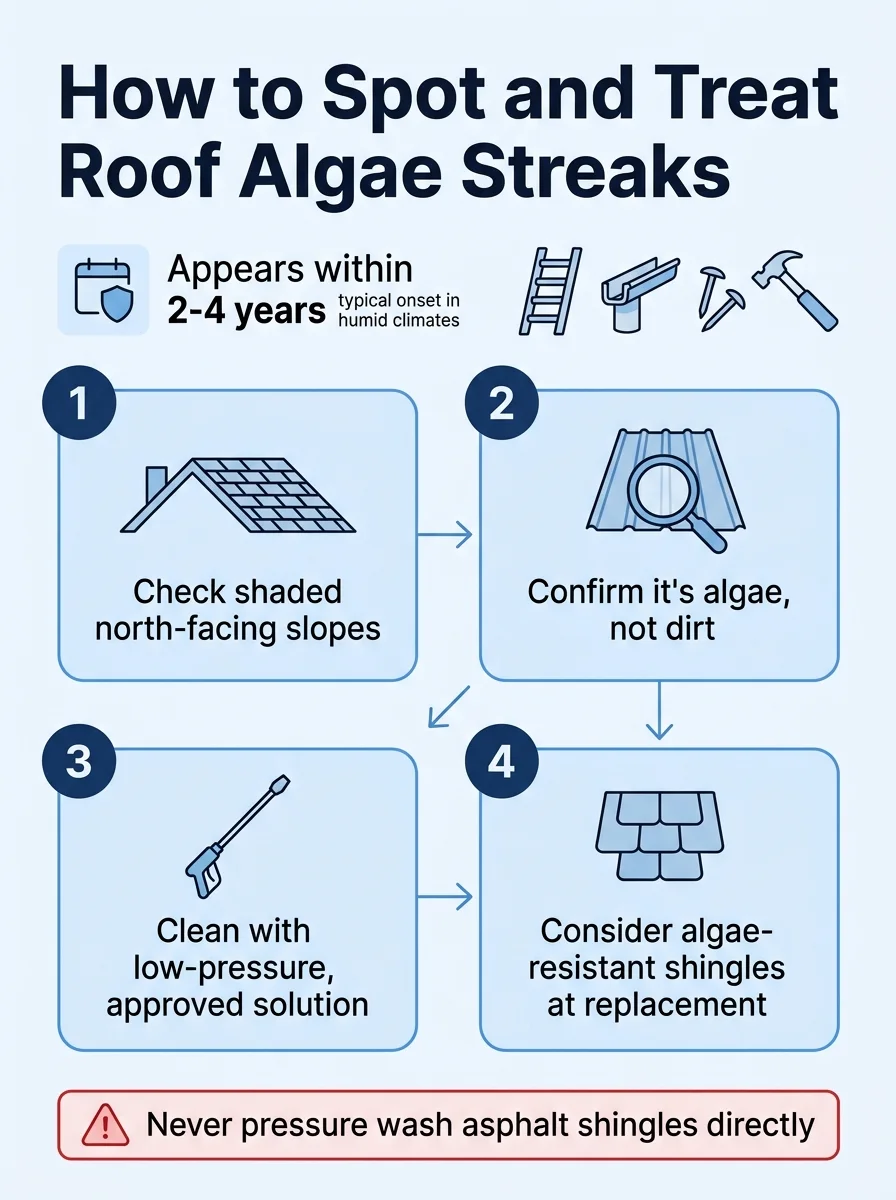
What Is Actually Growing on the Shingles
The organism responsible is a blue-green algae called Gloeocapsa magma. It travels by airborne spores, lands on a roof, and feeds on the limestone filler that's baked into most asphalt shingles. As colonies grow and die off, they leave behind a dark, pigmented residue that reads as a black or brownish streak, usually running downhill from a ridge or vent where moisture collects.
Why North-Facing Slopes Get Hit Hardest
North-facing slopes stay shaded longer through the day and hold moisture after rain or dew far longer than slopes that get direct sun. That combination of shade and dampness is exactly what algae needs to establish itself, which is why streaking almost always starts there before it ever shows up on a south or west facing roof plane.
Trees overhanging a roof make the problem worse by blocking sunlight and dropping organic debris that holds moisture against the shingle surface. Homes with mature tree cover in towns like Parkville or Liberty tend to see streaking develop faster than homes on open lots, even with the same shingles installed the same year.
Why It Spreads Instead of Staying Put
Algae spreads the way most airborne organisms do: spores from an established colony get carried by wind and rain runoff to nearby shingles, where they take root if conditions are right. That's why streaks usually start as a few thin lines near a vent or ridge cap and gradually widen into broader patches covering much of a shaded slope over several years.
Once a colony is established, it's tougher to fully eliminate without a proper cleaning, because the algae can survive dry spells and resume growing as soon as moisture returns. That's the main reason DIY rinsing with a garden hose rarely makes a lasting difference.
| Discoloration Type | What It Looks Like | What It Usually Means |
|---|---|---|
| Algae streaks | Dark gray or black streaks running downhill, usually on shaded slopes | Cosmetic growth, treatable with proper cleaning |
| Moss patches | Raised green or brown clumps, often near valleys or edges | Traps moisture and can lift shingles if left untreated |
| Rust staining | Orange-brown streaks below metal flashing or vents | Corroding metal component, not the shingle itself |
| Granule loss | Lighter, bald-looking patches with no dark coloring | Aging shingles, not algae, may signal replacement time |
What's Happening Beneath the Streak
The streaking itself sits on the surface of the shingle, but what's underneath matters more for the long-term health of the roof. Asphalt shingles are built with a fiberglass mat, an asphalt coating, and a layer of mineral granules that protect against UV and weather. Algae feeds on the limestone in that coating but doesn't typically eat through the shingle's structural layers on its own.
The bigger risk comes from how people try to remove the streaks. Aggressive scrubbing, harsh chemicals, or a pressure washer can strip those protective granules right along with the algae, exposing the asphalt layer underneath to direct sun and accelerating wear in a way the algae itself never would have.
Step-by-Step: Treating Algae Streaks the Right Way
Treating algae streaks safely comes down to using the right pressure, the right solution, and a little patience rather than brute force. Here's the general process most roofing professionals recommend for asphalt shingle roofs.
- Confirm the cause: Check that the discoloration is streaking on a shaded slope rather than moss, rust, or granule loss, since each needs a different approach.
- Choose a soft wash: Use a low-pressure sprayer, not a pressure washer, paired with a cleaning solution labeled safe for asphalt shingles.
- Apply from the top down: Work from the ridge toward the gutter line so the solution flows with gravity instead of forcing water up under shingle edges.
- Let it dwell: Give the solution time to work on the algae before rinsing, following the product's recommended wait time rather than rinsing immediately.
- Rinse gently: Rinse with a garden hose at normal household pressure, never a pressure washer attachment, to avoid stripping granules.
- Protect landscaping: Cover plants and shrubs below the roofline before cleaning, since runoff from cleaning solutions can harm grass and plant beds.
- Consider future prevention: Ask about algae-resistant shingles or zinc strips at the ridge when it's time for your next roof replacement to slow regrowth.
Is It Just Cosmetic, or a Sign of Something Else?
When Streaking Is Purely Cosmetic
In the large majority of cases, algae streaking is a cosmetic issue. The shingles underneath are still doing their job keeping water out, and the streaking doesn't speed up shingle failure on its own. If the roof is otherwise in good shape, with flat, intact shingles and no curling or granule bald spots, the streaks are a maintenance and appearance issue rather than a structural one.
A soft wash treatment, or in some cases a full shingle replacement if the homeowner is bothered enough by the look, is usually the end of the story. There's no reason to assume a streaked roof is in worse shape than it actually is.
When It Points to a Bigger Problem
Streaking becomes worth a closer look when it shows up alongside other warning signs: shingles that are curling at the edges, bald patches where granules have worn away entirely, or soft spots in the decking when walked on. Those symptoms usually mean the shingles are aging out on their own timeline, and the algae is just one more visible sign of a roof that's getting older, not the cause of the underlying wear.
If you're seeing streaking plus any of those other signs, it's worth having a roof repair professional take a look rather than assuming a cleaning alone will fix the appearance for good.
DIY Cleaning vs Calling a Professional
A homeowner comfortable on a ladder can often handle a basic soft wash treatment themselves, especially on a single-story home with easy roof access. Store-bought shingle-safe cleaning solutions and a garden-hose attachment sprayer are enough for light to moderate streaking, as long as you're patient about dwell time and gentle with the rinse.
Steep pitches, two-story homes, and heavily streaked roofs are where it makes more sense to call a professional. Working safely at height, applying the right concentration of cleaning solution, and avoiding damage to flashing or vents while cleaning around them takes experience, and a fall off a wet, algae-covered roof is a real risk worth avoiding.
A professional can also tell you, while they're up there, whether what looks like simple streaking is actually paired with granule loss or other aging signs worth addressing. That's a useful second opinion before you spend a weekend scrubbing a roof that might be due for more than a cleaning.
Keeping Streaks From Becoming a Bigger Headache
Algae streaking is one of those roofing issues that looks worse than it usually is, but ignoring it for years can leave shingles looking prematurely old and make an otherwise healthy roof harder to sell a home with. A soft wash every so often, especially on shaded slopes in towns like Overland Park or Gladstone, keeps a roof looking as good as it's actually performing.
If your roof is due for replacement anyway and streaking has been a recurring nuisance, ask about algae-resistant shingle options when you plan the project, and read up on what drives the cost of roof replacement in Missouri to understand what factors into that decision. Signature Roofing can take a look and tell you straight whether your roof needs a cleaning, a repair, or nothing more than time.
Frequently asked questions
What causes the black streaks on my roof?
The dark streaking is almost always a blue-green algae called Gloeocapsa magma, not soot or mold. It feeds on the limestone filler in asphalt shingles and thrives in humid climates, which is why it shows up so often on homes in the Missouri area.
Will the streaks go away on their own?
No, algae streaks don't fade on their own and usually get darker and spread over time. Rain alone won't rinse it off because the organism is actually growing on and into the shingle surface, not just sitting on top of it.
Can I pressure wash the streaks off?
You shouldn't pressure wash asphalt shingles, since the force can strip protective granules and shorten the shingle's life. A soft wash with a low-pressure sprayer and a manufacturer-approved cleaning solution is the safer route.
Are algae streaks a sign my roof is failing?
In most cases algae streaks are cosmetic and don't mean the roof is failing. They become a concern only when paired with other issues like curling, bald spots, or soft decking, which point to the shingles aging out rather than just discoloring.
Do algae-resistant shingles actually work?
Algae-resistant shingles contain copper or zinc granules that slow algae growth and they hold up noticeably better in humid climates than standard shingles. They don't make streaking impossible forever, but they buy years before it becomes visible.