
Why a Missouri roof needs attention every season
A roof in the Kansas City metro doesn't get a break. Spring brings hail and straight-line wind, summer brings stretches of heat and intense UV exposure, fall drops leaves and branches across the surface, and winter swings between snow, ice, and freeze-thaw cycles. Few climates ask this much of a roofing system in a single calendar year.
That range of weather is exactly why a seasonal check makes sense instead of a once-and-done approach. Damage from a spring storm can sit unnoticed until summer heat works it loose, and debris left over the summer can clog drainage right as fall rain and winter snow arrive. Walking through what to look for each season gives you a simple rhythm to follow instead of guessing when something needs attention.
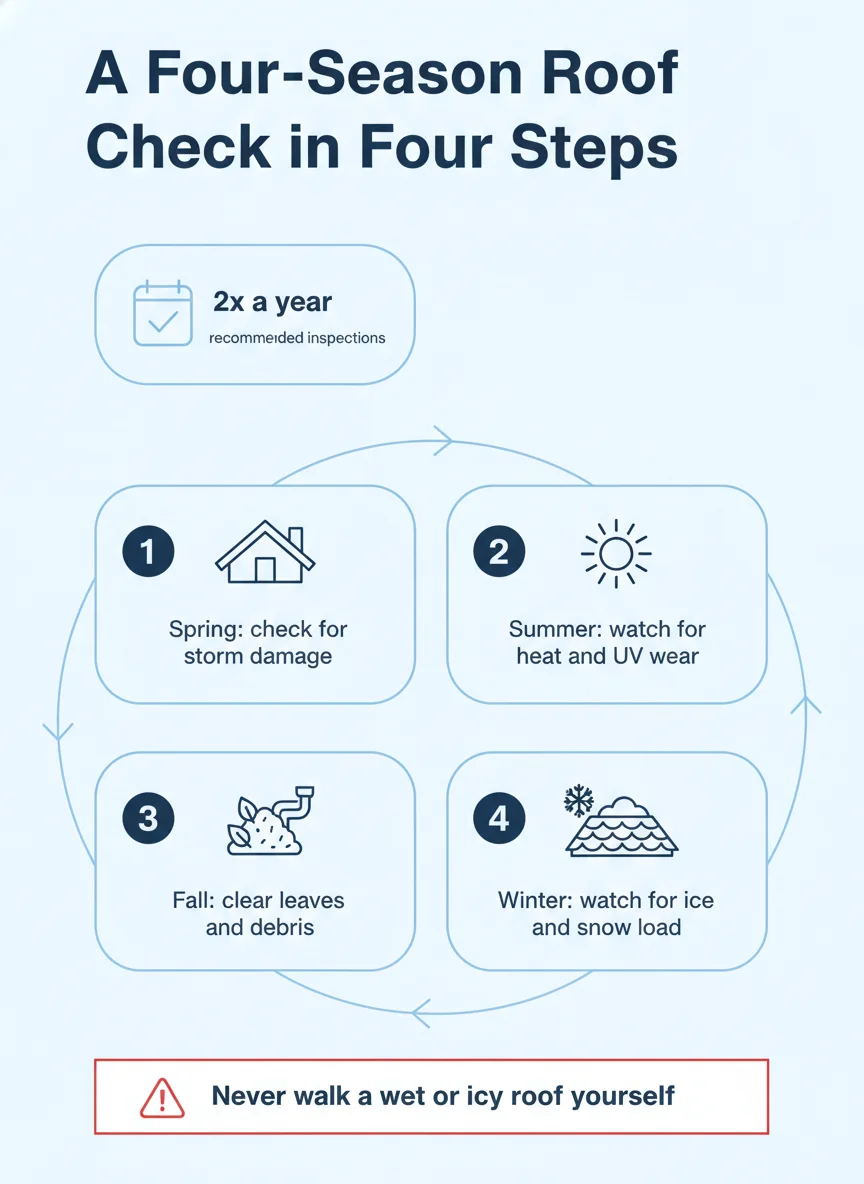
Why seasonal wear shows up differently each time of year
The reason a roof needs different checks in April than it does in November comes down to how materials respond to temperature and moisture. Shingles expand in heat and contract in cold, and that constant movement is part of normal aging, but sudden impacts or standing water speed it up. Understanding what's driving the wear in each season helps you know what you're actually looking for.
Spring: impact and wind stress
Spring storm season in Missouri brings the two things roofs handle worst, hail impact and sustained high wind. Hail can bruise or crack shingle granules in ways that aren't obvious from the ground, and wind can lift shingle edges or peel them off entirely. This is the season most likely to produce sudden, visible damage rather than slow wear.
A spring check is also the right time to look at anything that sticks up above the roofline, vents, chimneys, and flashing, since wind tends to target those edges first. If a storm has come through recently, a ground-level look followed by a professional Storm & Hail Damage Repair assessment is the safest way to know what's actually going on up there.
Summer and winter: slow wear versus sudden stress
Summer heat in Missouri pushes roof surface temperatures well above the air temperature, and that heat plus UV exposure is what gradually breaks down shingle granules and asphalt over the years. It's a slow process, so summer checks are more about looking for curling, cracking, or granule loss in gutters than finding one dramatic problem.
Winter works differently. Snow load, ice buildup at the edges, and repeated freeze-thaw cycles put mechanical stress on the roof surface and anything sealed with caulk or sealant. The damage from a hard winter often doesn't show up as a leak until the spring thaw, which is one more reason the two seasons are usually checked together rather than treated as separate problems.
| Season | What to watch for | Why it matters |
|---|---|---|
| Spring | Hail bruising, lifted or missing shingles, dented vents | Sudden storm damage that can lead to leaks if missed |
| Summer | Curling shingles, granule loss, heat-cracked sealant | Slow UV and heat wear that shortens roof lifespan |
| Fall | Leaf and debris buildup, clogged gutters, loose flashing | Trapped moisture that sets up winter problems |
| Winter | Ice buildup at eaves, heavy snow load, ice dams | Freeze-thaw stress and water pushed back under shingles |
The parts of the roof that take the brunt of seasonal change
Most seasonal wear concentrates on a handful of specific areas rather than spreading evenly across the whole roof. The edges, where shingles meet gutters and fascia, take the worst of wind uplift and ice buildup. Flashing around chimneys, skylights, and vent pipes is the most common spot for small gaps to open up as materials expand and contract through the year.
The attic matters just as much as the roof surface itself. Poor attic ventilation traps summer heat against the underside of the decking and lets winter heat escape upward, which is a major contributor to both shingle aging and ice dam formation. A seasonal roof check that only looks at the outside is missing half the picture.
Step-by-step: a seasonal roof walk-around
You don't need to get on a ladder to do a basic seasonal check. A pair of binoculars and a walk around the house covers most of what matters, and it tells you whether it's time to call for a closer look.
- Walk the perimeter: Look up at the roofline from the ground on all four sides of the house, scanning for missing, lifted, or discolored shingles.
- Check the gutters: Look for granules collecting in the gutters, which signal accelerated shingle wear, along with leaves or debris that could trap water.
- Look at flashing points: Check chimneys, skylights, and vent pipes for gaps, rust, or lifted edges where water could work its way underneath.
- Inspect the attic: If accessible, look for daylight coming through the roof deck, damp insulation, or staining on the underside of the sheathing.
- Note any storm activity: After hail or high wind, write down the date and any visible debris in the yard, like broken shingle pieces or granules.
- Schedule a professional look: Twice a year, or after any notable storm, have a roofer take a closer look at anything you flagged or couldn't see clearly.
What a seasonal check usually turns up
A spring or fall walk-around doesn't always find a problem, and that's a good outcome. But when it does, the findings tend to fall into a few predictable categories depending on the season and the age of the roof.
Minor wear that can wait
Some granule loss in the gutters, a slightly curled shingle edge, or minor discoloration from UV exposure are normal signs of aging on a roof that's several years in. These don't usually require immediate action, but they're worth noting and watching over the next season to see if they progress.
Loose debris like small branches or a buildup of leaves also falls into this category. It's not damage on its own, but leaving it in place through a wet season can trap moisture against the shingles and speed up wear in that one spot.
Findings that need a closer look soon
Visible gaps in flashing, shingles that are cracked or missing in a cluster rather than one or two scattered spots, and any sign of water staining inside the attic are findings that shouldn't sit until the next scheduled check. These point to an opening where water is getting, or could soon get, underneath the roof's protective layers.
Dented or displaced vents, bruised shingle surfaces after hail, and granule loss concentrated in one area rather than spread evenly are also worth a professional assessment, since they can be early signs of storm damage that isn't obvious from the ground.
What a homeowner can check versus what needs a licensed roofer
A homeowner can safely handle the ground-level parts of a seasonal check: looking up from the yard, checking gutters from a stable ladder on dry ground, and glancing into the attic through an existing access point. These don't require walking the roof surface itself and give you a reasonable sense of whether something looks off.
Getting on the roof itself is a different matter. Slopes, wet or icy surfaces, and the risk of stepping on already-weakened decking make it a job for someone with the right equipment and experience. A licensed roofer also knows what subtle hail bruising or lifted flashing looks like up close, details that are nearly impossible to judge accurately from the ground.
Insurance and warranty considerations are another reason to bring in a professional for anything beyond a visual check. Climbing on the roof yourself to attempt a repair can complicate a future insurance claim, and it can void manufacturer or workmanship warranties depending on the terms. A professional visit keeps both the paperwork and the roof itself in good standing.
Building the habit into your year
The easiest way to keep up with a seasonal roof calendar is to tie it to something you already do twice a year, like changing furnace filters or doing a general home walk-around. Spring and fall are the two natural check points for the Kansas City metro, bracketing the most severe weather on either side.
If you want more detail on preparing specifically for the cold months, Getting a Missouri Roof Ready for Winter covers that season in depth, and homes in Kansas City and the surrounding metro follow the same seasonal pattern described here. Keeping up with these checks, and having a professional take a look when something seems off, is one of the simplest ways to get the full expected lifespan out of a roof, and it's a habit Signature Roofing encourages every homeowner in the area to build.
Frequently asked questions
How often should I have my roof inspected in Missouri?
Twice a year is the general rule for the Kansas City metro, once in spring after storm season settles and once in fall before winter weather sets in. A homeowner who just went through a hailstorm or a major windstorm should also schedule a look sooner rather than waiting for the regular check.
What season is hardest on a Missouri roof?
Spring tends to cause the most sudden damage because of hail and high wind, while summer heat and winter freeze-thaw cycles cause slower, cumulative wear. Over a full year, the roof is working against all four seasons, which is part of why regular checks matter more here than in milder climates.
Do I need to check my roof after every storm?
A quick visual check from the ground after any strong storm is a good habit, looking for missing shingles, dented vents, or debris in the yard. If you see signs of damage or you're not sure, it's worth having a professional take a closer look before small damage turns into a leak.
Can ice dams happen on Missouri roofs?
Yes, ice dams can form in Missouri during winter cold snaps, especially when heat escaping from the attic melts snow on the roof that then refreezes at the edges. They're more common on homes with poor attic insulation or ventilation, and they can push water back up under shingles.
What's the one season homeowners forget to check their roof?
Fall is the season most often skipped, probably because there's no obvious storm or heat wave pushing it to the top of the list. But clearing leaves and debris before winter is one of the simplest ways to prevent trapped moisture and ice problems later in the season.