
Why Attic Ventilation Matters More Than It Looks Like It Should
Most homeowners never think about their attic until something goes wrong with the ceiling below it or the roof above it. But the attic is doing more work than people realize. It's the buffer zone between the outside air and the living space, and whether it breathes properly affects everything from energy bills to how long the roofing material up top actually lasts. In the Kansas City metro, where summers push attics well past 120 degrees and winters bring hard freezes, that buffer zone gets tested twice a year in opposite directions.
A roof system is built to handle sun, rain, and wind from the outside. What it's not built to handle as well is heat and moisture pressing up from underneath, which is exactly what happens when an attic can't move air the way it should. Over years, that trapped heat and humidity work on the shingles, the decking, and the insulation from the inside, often well before anyone notices a leak. By the time a stain shows up on a ceiling, the damage underneath may have been building for seasons.
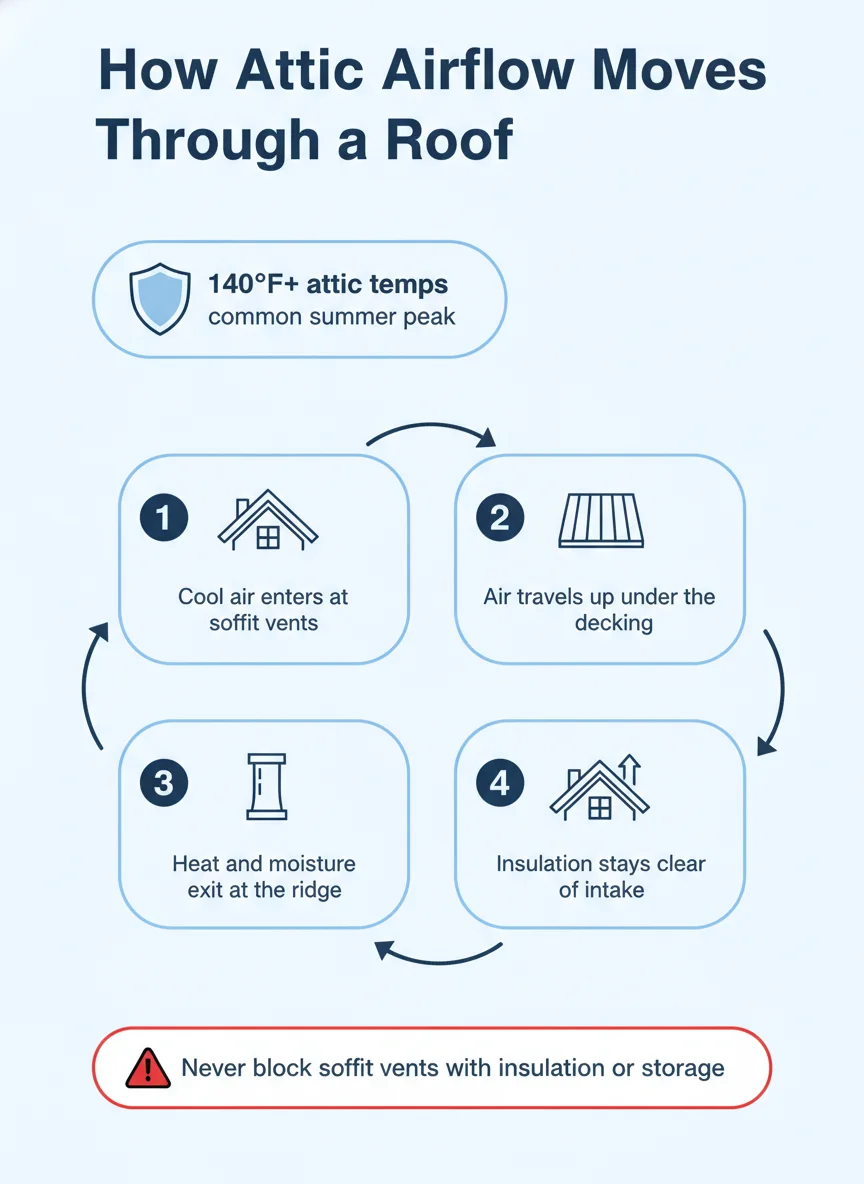
How Intake and Exhaust Ventilation Work Together
Attic ventilation isn't one vent doing one job, it's a system of two parts moving air in a continuous loop. Cool, dry air needs a way in low on the roof, and hot, moist air needs a way out high on the roof. When both sides are open and balanced, air moves constantly through the attic space, carrying heat and moisture with it instead of letting them settle.
Intake: Where Fresh Air Gets In
Intake ventilation almost always happens at the soffits, the underside of the roof overhang along the eaves. Small perforated vents or a continuous vent strip let outside air flow up into the attic from the lowest point of the roof. Because intake sits at the bottom, it relies on nothing blocking its path, which is where insulation most often becomes a problem.
If insulation gets pushed all the way to the outer edge of the attic floor, it can bury the soffit vents from the inside, even though the vents still look fine from the yard. A baffle, a simple rigid channel installed between the rafters before insulation goes in, keeps that path open permanently. It's a small detail that makes the difference between a vent that exists and a vent that actually works.
Exhaust: Where Heat and Moisture Get Out
Exhaust ventilation sits at the highest point of the attic, most often a ridge vent running along the peak of the roof, though some homes use box vents, turbine vents, or powered fans instead. Because heat rises, this is the natural exit point, and it's where the air that entered at the soffits finally leaves, taking built-up heat and humidity with it.
A ridge vent works passively, with no moving parts, using the natural pressure difference between the attic and the outside air to pull air through. That makes it low maintenance, but it also means it depends entirely on a clear intake path below. An exhaust vent with no matching intake is like a chimney with the damper shut, it has nowhere to draw air from.
| Season | What Poor Ventilation Looks Like | What It Does to the Roof |
|---|---|---|
| Summer | Attic temps climb well above outdoor air, upstairs rooms run hot | Accelerates shingle aging from the underside |
| Winter | Frost or dripping moisture on the underside of the decking | Soaks wood sheathing, invites rot and mold |
| Year-round | Musty smell or visible staining when entering the attic | Signals trapped humidity with nowhere to escape |
What's Actually Up There: The Parts of an Attic Ventilation System
A ventilation system is made up of a handful of straightforward parts: soffit vents at the eaves, a ridge vent or other exhaust vents at the peak, baffles keeping the path clear between them, and the insulation that fills the attic floor without smothering the intake. None of these parts is complicated on its own, which is part of why ventilation problems go unnoticed. Everything can look installed and intact while still not functioning as a system.
The building codes most homes are built to call for a set ratio of vent area to attic floor space, split between intake and exhaust, which is why a roofer checking ventilation is often doing some basic math alongside a visual inspection. A roof that was properly vented when it was built can still end up under-ventilated years later if insulation gets added, a bathroom fan gets vented into the attic instead of outside, or vents get painted over or covered during other home improvement work.
Step-by-Step: How a Roofer Checks Attic Ventilation
A ventilation check is usually part of a broader look at the roof and attic, not a separate appointment on its own. Here's generally how it goes.
- Check the soffits: We look at the soffit vents from outside and, where accessible, from inside the attic to confirm air is actually moving through them.
- Inspect the insulation line: We check whether insulation has crept over the eaves and is blocking the intake path, and whether baffles are in place.
- Look at the exhaust vents: We check the ridge vent or other exhaust vents for debris, paint, or damage that could be restricting airflow out of the attic.
- Look for moisture signs: We check the underside of the decking and rafters for staining, frost in cold months, or soft spots that point to trapped moisture.
- Check attic temperature and smell: A musty smell or extreme heat buildup during a daytime visit is often the fastest clue that airflow isn't keeping up.
- Confirm vent balance: We compare how much intake and exhaust area the attic has against what the space actually needs.
How to Tell What You're Actually Dealing With
Summer Symptoms: Heat Buildup
In the hottest months, poor ventilation usually shows up as an attic that's noticeably hotter than it should be and upstairs rooms that stay warm no matter how hard the air conditioner runs. That trapped heat radiates down through the ceiling and also bakes the shingles from underneath, which is the kind of stress a roof isn't designed to absorb from both directions at once.
Shingles that curl, crack, or look visibly worn years before the rest of a comparable roof in the neighborhood are often a sign the attic underneath them has been running hot for a while. It's one of the reasons two roofs installed the same year in the same material can age at very different rates, depending on what's happening in the attic beneath them.
Winter Symptoms: Trapped Moisture
Cold weather flips the problem around. Warm, moist air from inside the house rises into the attic, and if it can't escape, it condenses on the cold underside of the roof deck. Frost on exposed nail points on a cold morning, or dripping moisture once the attic warms up, is a classic sign of a ventilation imbalance rather than a roof leak, even though it can look like one from inside the house.
Left unaddressed, that moisture soaks into the wood decking and rafters over time, creating conditions for rot and mold that weaken the structure a roof is fastened to. A homeowner dealing with recurring ceiling stains that don't line up with any obvious roof damage should consider attic condensation as a possible cause, not just an aging roof.
What You Can Check Yourself vs. What Needs a Roofer
A homeowner can do a basic visual check without any special tools. From the yard, look at the soffits for obvious blockages like bird nests, paint buildup, or missing vent covers, and look at the ridge line for damage or debris. Inside the attic, if it's safely accessible, a flashlight check for daylight at the soffits and any staining or frost on the underside of the roof deck can tell you a lot in a few minutes.
What's harder to judge from the ground is whether the vent sizing is actually balanced for the attic's square footage, and whether insulation has shifted enough to choke off intake without being visibly obvious. That calculation, along with any work that involves cutting in new vents, adding baffles, or correcting an exhaust system that's undersized, is roofing and attic work that calls for a licensed professional.
If a roof replacement is already on the table for other reasons, like age or storm damage, it's also the easiest time to correct ventilation problems, since the roof deck and vent locations are already exposed during the project. Fixing ventilation at the same time as a replacement avoids paying for access to the same area twice.
Keeping a Roof Working From the Inside Out
Attic ventilation doesn't get the attention that shingles, gutters, or flashing get, mostly because it's invisible from the street and easy to assume is fine if nothing has leaked yet. But a roof that's breathing properly ages more evenly, holds up better through both the Missouri summer heat and winter freeze, and gives the materials up top a fair shot at reaching their expected lifespan, a topic covered in more detail in How Long Does a Roof Last in Missouri?.
Homeowners in Kansas City and the surrounding metro dealing with high summer cooling bills, frost in the attic, or shingles that look older than they should have a straightforward way to find out what's going on: have someone look at both the roof and the attic together. Signature Roofing checks ventilation as part of its roof inspections, since a roof and the air space underneath it are really one system.
Frequently asked questions
How do I know if my attic has bad ventilation?
The clearest signs are a attic that feels noticeably hotter than outside air in summer, frost or moisture on the underside of the roof deck in winter, and shingles that curl or look prematurely worn from the top down. High cooling bills in summer can also point to trapped attic heat radiating into the living space below.
What is the difference between intake and exhaust vents?
Intake vents, usually placed at the soffits under the eaves, let cool outside air into the attic, while exhaust vents, typically along the ridge or through roof-mounted vents, let hot and moist air escape at the top. Both have to work together, since exhaust vents can't pull air that has nowhere to come in from.
Can too much insulation cause roof problems?
Yes, if insulation is pushed too far into the eaves it can block the soffit vents and cut off intake airflow entirely. Baffles, which are rigid channels installed between the rafters, keep a clear air path from the soffit to the attic even when insulation is piled up to the recommended depth.
Does poor attic ventilation shorten the life of shingles?
It can, because trapped heat accelerates the normal aging process of asphalt shingles and trapped moisture can rot the decking underneath them. A well-ventilated attic keeps both heat and humidity closer to outdoor levels, which helps the roofing material age the way it's designed to.
How can I check my own attic ventilation?
Start by looking for daylight or a breeze at the soffit vents from inside the attic, and check whether the ridge or exhaust vents are clear of debris and paint. If you notice frost on nail points in winter or the attic feels unusually hot and stuffy in summer, it's worth having a roofer take a closer look.