
Spring Storms and the Kansas City Metro
Spring and early summer bring some of the most active hail weather in the country to the Kansas City metro, and homes from Riverside to Overland Park see their share of it most years. A fast-moving storm cell can drop hail ranging from pea-sized to golf-ball-sized in a matter of minutes, and the roof usually takes the brunt of it since it's the most exposed, flattest surface on the house.
The tricky part is that hail damage doesn't always announce itself. A dented car hood or a shredded garden umbrella is obvious. A bruised shingle thirty feet up is not. Knowing what to look for from the ground gives you a head start on deciding whether it's worth getting a closer look, and it helps you act before a small bruise turns into a leak during the next downpour.
Why Hail Damages Shingles the Way It Does
Asphalt shingles are built with a layer of granules pressed into a tar and fiberglass mat. Those granules do two jobs: they shield the mat from UV light, and they give the shingle its grip and color. When a hailstone strikes with enough force, it knocks granules loose and bruises the mat underneath, sometimes without ever breaking the surface. That's why hail damage so often looks subtle instead of dramatic.
What Hail Does to Shingles
A fresh hail hit on a shingle usually shows up as a dark, slightly soft spot, almost like a bruise on fruit. Press on it gently and it may feel spongy compared to the surrounding shingle. Granule loss around the impact point is common, and you might see bare, shiny asphalt peeking through in a small circular pattern. None of this is usually visible from your yard, which is exactly why ground-level checks focus on other clues instead.
Over time, an exposed mat accelerates aging in that one spot. UV rays break down the asphalt faster where the granules are gone, and the shingle becomes more prone to cracking or curling at the bruise. That's the mechanism behind a hailstorm causing a leak months later instead of immediately.
What Hail Does to Soft Metals
Soft metal components around your house take hail damage differently than shingles do, and they're a lot easier to spot without a ladder. Gutters, downspouts, vent caps, and even the fins on your outdoor AC unit are made of thinner metal, so hail tends to leave visible dents instead of hidden bruises.
Walk your gutter line after a storm and look for small dimples or dings, especially on the side that faced the wind. Check your AC unit's fins for the same pattern of dents. If you see consistent damage on these softer surfaces, it's a strong sign the roof above them took a similar beating, even if the shingles themselves look fine from where you're standing.
| Surface | What Ground-Level Damage Looks Like | What It Suggests |
|---|---|---|
| Gutters and downspouts | Small dents or dimples along the edge | Hail of meaningful size hit the property |
| Vent caps and flashing | Dings, chipped paint, or dented edges | Impact strong enough to affect nearby shingles |
| AC unit fins | Flattened or dented fin pattern | Hail came in at an angle that likely hit the roof too |
| Shingles (binoculars) | Dark spots or missing granules in a cluster | Possible bruising, warrants a closer inspection |
The Role of Hail Size
Hail size matters more than most homeowners expect. Pea-sized hail, even in a heavy burst, rarely does more than cosmetic damage to a healthy roof. Once hail reaches around an inch in diameter, roughly the size of a quarter, the odds of real shingle bruising go up noticeably. Golf-ball-sized hail or larger can crack shingles outright and dent even sturdier metal components.
Wind matters too. A storm with strong, gusting wind drives hail sideways instead of straight down, which means it can hit the sides of a roof slope harder than the flatter areas. That's part of why damage is often uneven across a roof, heavier on one side than another, depending on which direction the wind was blowing during the worst of the storm.
Step-by-Step: Checking Your Roof From the Ground
You don't need special equipment to do a first-pass check after a storm. A pair of binoculars, a flashlight for your gutters, and a slow walk around the property will tell you a lot before you ever need to call anyone.
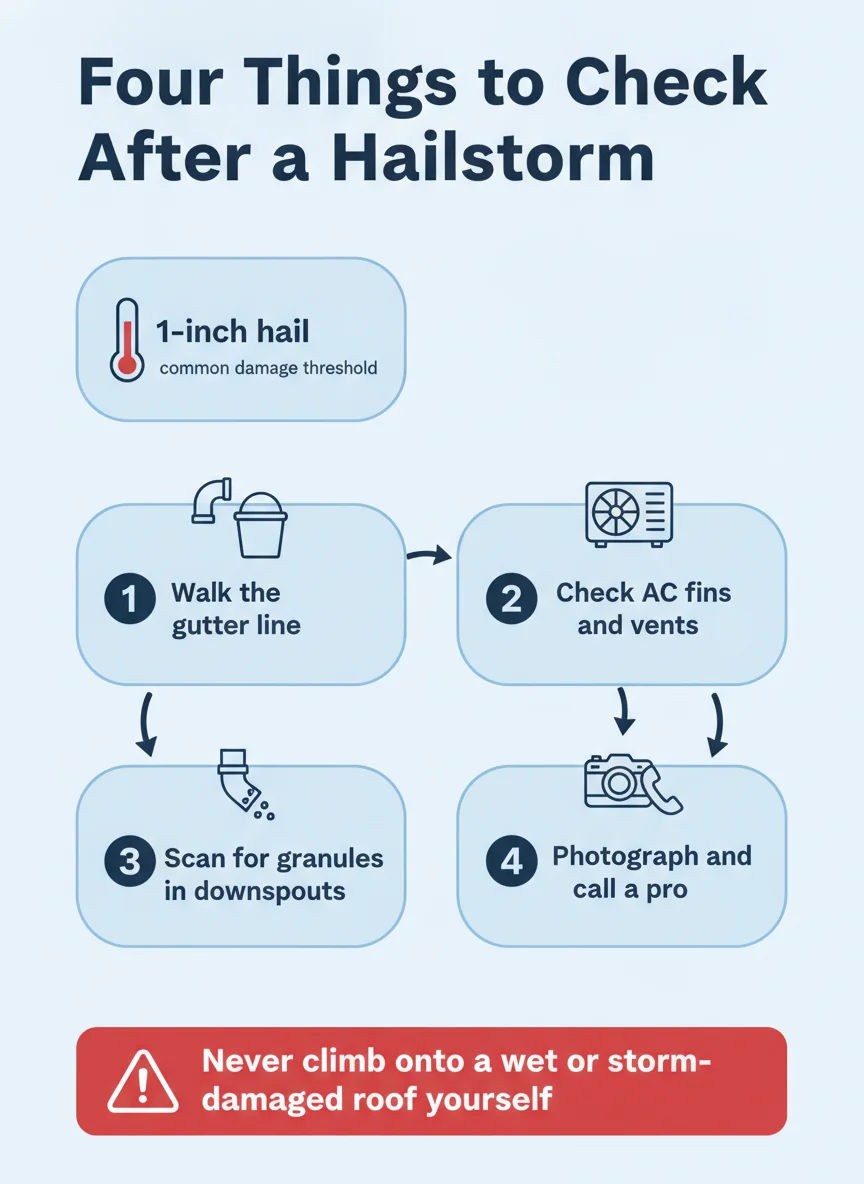
- Walk the gutter line: Look along every gutter and downspout for small dents or dimples, paying extra attention to the side that faced the storm.
- Check soft metal fixtures: Inspect vent caps, roof flashing, and your outdoor AC unit's fins for the same dented pattern as the gutters.
- Look at downspout screens: Granules washed off the shingles often collect in downspouts and gutter screens after a hailstorm, even when the shingles look fine from below.
- Use binoculars on the slopes: Scan each visible roof slope for dark, clustered spots or patches that look different in texture from the surrounding shingles.
- Check the yard and siding: Dented siding, damaged window screens, or torn leaves on nearby trees all confirm the storm was strong enough to affect the roof.
- Photograph everything: Take dated photos of any dents, debris, or granule buildup you find, since this documentation helps later if you file a claim.
- Call for a professional look: Once you've gathered what you can see, schedule an inspection so someone can safely get up on the roof and confirm what's actually happening to the shingles.
What a Closer Inspection Usually Finds
Isolated Bruising
On many roofs, a professional inspection turns up a scattering of bruised shingles rather than widespread destruction. These are often concentrated on one or two slopes, usually the ones that faced the storm's wind direction. In this case, the roof may still be sound overall, but those specific shingles need attention before they turn into leak points.
This is also the scenario where documentation matters most for insurance purposes. A handful of bruised shingles can be easy for an insurance adjuster to miss or dismiss without clear photos and a written assessment from someone who inspects storm damage regularly.
Widespread Granule Loss and Cracking
On older roofs, or roofs hit by larger hail, an inspector may find granule loss and cracking across most of the surface rather than in a few isolated spots. This pattern usually means the roof's remaining lifespan took a real hit, even if it isn't actively leaking yet.
When damage is this widespread, a storm and hail damage repair visit typically turns into a broader conversation about whether a full roof replacement makes more sense than patching dozens of individual shingles.
What You Can Check Yourself vs. What Needs a Pro
Everything described above, the gutter walk, the binocular scan, the photos, is safe and reasonable for a homeowner to do solo. None of it requires getting on the roof, and all of it gives you useful information to work with before you make any calls.
What you shouldn't do is climb onto the roof yourself to look closer, especially right after a storm. Wet shingles, loosened granules, and damaged decking underneath can all make footing unpredictable, and a fall is a far bigger risk than a missed shingle. A trained inspector knows how to walk a storm-damaged roof safely and has a trained eye for the subtle bruising that's easy to miss.
If your ground-level check turns up any of the signs above, that's the point to bring in a professional rather than guess. An inspection can confirm whether you're looking at a minor repair or something more significant, and it gives you documentation if you end up filing a claim.
Getting Help After the Storm Passes
A thorough ground-level check takes twenty minutes and costs nothing, but it's often the difference between catching a problem early and discovering a leak months later during the next heavy rain. If you spot dented gutters, damaged vents, or anything suspicious on the slopes through binoculars, treat it as a reason to get a closer look rather than something to wait out.
Signature Roofing has spent over 20 years working on homes throughout the Kansas City metro, and we're familiar with how hail tends to affect roofs in this region, from the gutters to the shingles themselves. If your ground check turns up anything worth a second look, give us a call and we'll help you figure out what's next.
Frequently asked questions
Can you see hail damage from the ground?
You can often spot indicators from the ground, like dented gutters, dinged vent caps, and dimpled AC fins, but the shingles themselves are harder to judge without getting closer. A professional inspection is the only reliable way to confirm shingle damage.
How big does hail need to be to damage a roof?
Hail around an inch in diameter, roughly the size of a quarter, is generally considered the point where shingle damage becomes likely, though softer or older shingles can bruise from smaller stones. Wind speed and the angle of impact also play a role.
What does hail damage on a shingle actually look like?
Hail damage usually shows up as a dark, soft bruise where the hailstone knocked granules loose, exposing the asphalt mat underneath. It doesn't always leave an obvious hole or crack, which is why it's easy to miss during a casual look from the yard.
Why does hail damage sometimes not show up right away?
A bruise on a shingle can sit quietly for months before it turns into an active leak, because the damage starts as weakened material rather than an immediate hole. That's why many homeowners don't notice an issue until the next heavy rain or wind event.
Should I file an insurance claim before or after an inspection?
Most homeowners get an inspection first so they know whether there's enough documented damage to support a claim. Signature Roofing can help you understand what an inspector is likely to find and walk you through the next step.