
Why leaks show up more in Missouri than people expect
Kansas City area homes deal with a wide swing of weather across the year, from heavy spring downpours to ice and freeze-thaw cycles in winter. Roofing materials expand and contract with those swings, and any small gap around a penetration, a valley, or an aging section of shingles becomes a path for water to travel once conditions line up right. A stain doesn't always show up the day the leak starts either, so by the time you see it on the ceiling, water has often been finding its way in for a while.
That lag is part of why a ceiling stain catches homeowners off guard. The moisture usually travels along the roof deck or a framing member before it drips down in a spot that has nothing to do with where the water actually entered. That's normal, and it's one of the main reasons a proper inspection starts in the attic instead of guessing from the roof surface alone.
What's actually happening up there
Three situations account for most calls about a leak or a stain. Each one has a different urgency level and a different fix, which is why an accurate diagnosis matters more than a quick patch.
Active leak at a penetration or damaged section
This is water actively coming through right now, usually around a vent pipe, a damaged or missing shingle, or a section where the underlayment has failed. It tends to show up during or right after a heavy rain and can grow quickly if the opening is large or the storm is prolonged.
Because this type is actively adding moisture to the structure, it's the version worth getting looked at sooner rather than later. Left alone, it can lead to soaked insulation, sagging drywall, or damage to framing that turns a repair into something bigger.
Slow leak at flashing, a pipe boot, or a valley
Flashing and pipe boots are the metal and rubber pieces that seal transitions, chimney bases, vent stacks, and valleys where two roof planes meet. These components wear out well before the shingles around them do, and a slow leak here might only show up during wind-driven rain from a specific direction.
This kind of leak can sit for weeks without an obvious sign, which is exactly why routine checks matter. It's rarely an emergency in the moment, but it should get on the schedule since the damage compounds quietly behind the scenes.
| Signal | Likely Cause | Urgency |
|---|---|---|
| Drip during heavy rain, spreading fast | Active leak at penetration or damaged shingles | High, address soon |
| Stain grows slowly over weeks | Flashing, valley, or pipe boot wear | Moderate, schedule a visit |
| Musty smell, damp insulation, no clear drip | Attic condensation or ventilation issue | Moderate, worth checking |
What a homeowner can check before calling
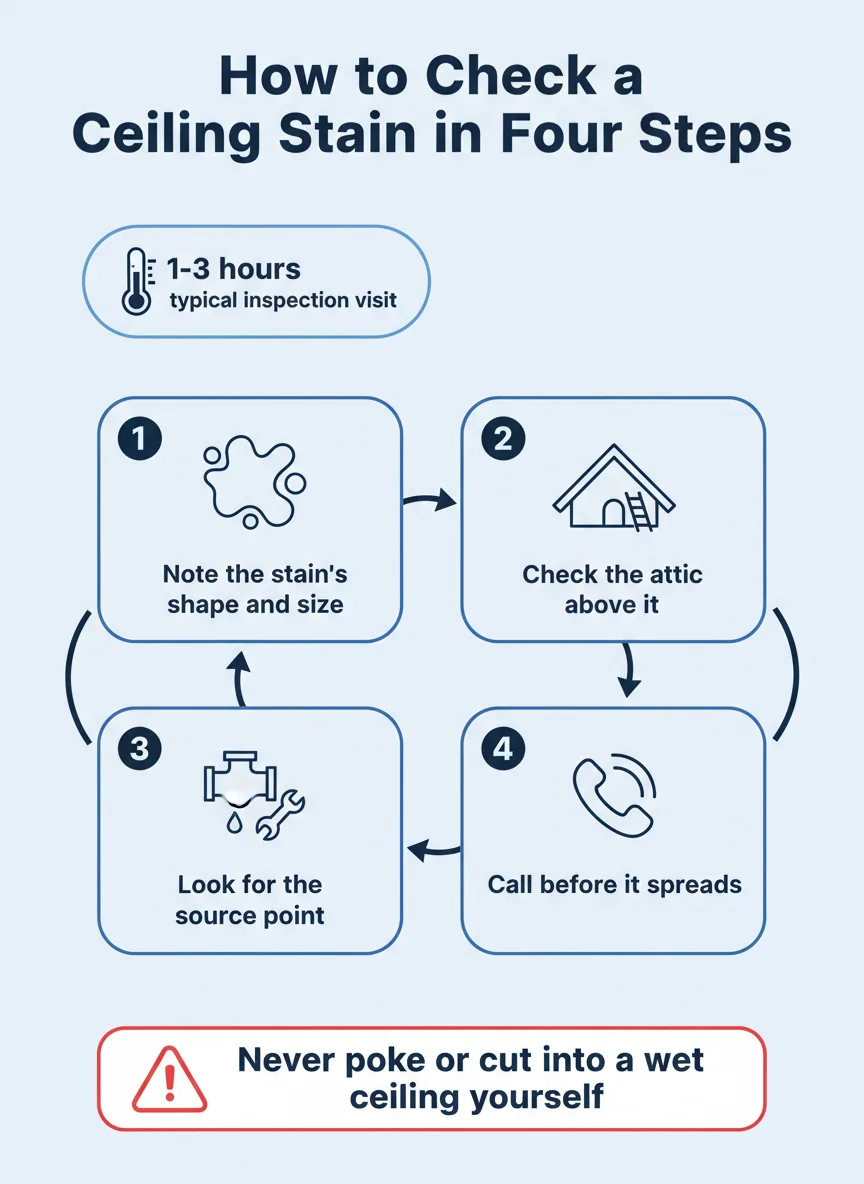
You don't need to climb on the roof to gather useful information. Check the attic with a flashlight during or right after rain if it's safe to do so, and look for a wet trail on the underside of the decking, damp insulation, or dark staining on rafters. Note roughly where the stain sits on the ceiling below and whether it's near a chimney, vent pipe, skylight, or exterior wall, since those are the most common trouble spots.
It also helps to note the weather pattern when the stain appears or grows. A leak that only shows up during wind out of one direction points toward a flashing or valley issue on that side of the roof, which saves time once someone is up there looking.
Step-by-step: what a leak inspection visit typically looks like
A typical stop for a leak call runs one to three hours depending on the size of the roof and how far the water has traveled before showing up. Here's roughly how it goes.
- Attic check first: The roofer looks for the moisture trail on the underside of the deck and framing before ever climbing on the roof surface.
- Match it to a roof point: Once the trail is traced, they walk the roof to find the matching penetration, valley, or worn section from above.
- Check surrounding material: They'll look at the shingles, flashing, and underlayment around the source point for wear or damage that needs addressing too.
- Document what's found: Photos and notes on the source and extent of the damage, useful whether you're paying out of pocket or working with an insurer.
- Discuss the fix: You'll get an explanation of whether it's a targeted repair or a sign of a larger issue worth a closer look.
What you'll typically find once the source is located
Most active leaks trace back to one of a handful of failure points. A cracked or worn pipe boot around a vent stack is one of the more common culprits, since the rubber seal degrades faster than the shingles around it. A gap or lifted section at a chimney or wall flashing is another frequent find, especially after a hard winter or a windy season.
When it's a targeted repair
If the source is isolated, like one failed pipe boot or a small section of damaged shingles, a repair usually resolves it. The surrounding material gets checked too, since water damage often spreads a bit past the original entry point even if the rest of the roof is in good shape.
When it points to something bigger
If the inspection turns up multiple soft spots, widespread granule loss, or a roof that's simply reached the end of its service life, a repair might only buy limited time. That's a conversation worth having honestly rather than patching the same spot again next season.
What you can check yourself versus what needs a licensed roofer
Checking the attic, noting the stain's pattern, and watching for changes after rain are all things a homeowner can safely do without any special equipment. This kind of observation actually speeds up the eventual repair, since it gives the roofer a head start on where to look.
Climbing on the roof itself, especially a wet one, isn't something to take on solo. Roof surfaces get slick fast and the pitch on most residential roofs makes footing unpredictable even for experienced climbers. There's also real value in a trained eye spotting wear that looks minor to an untrained one but signals a bigger problem underneath.
Licensed roofers also carry the liability coverage and experience to work safely at height, and they know what a normal amount of wear looks like versus what needs attention now. That judgment call is hard to make accurately from a ladder in your own driveway.
Getting ahead of the next one
A stain on the ceiling is rarely the emergency it feels like in the moment, but it's also not something to leave alone once you've spotted it. Catching it while it's still one isolated spot usually means a straightforward roof repair instead of a bigger project down the line, and it's worth checking signs your roof needs attention for other early indicators worth watching.
If you're in Kansas City or one of the surrounding communities and you've spotted a stain that's new or growing, it's worth having it looked at before the next round of rain adds to it. Signature Roofing has served the metro for over 20 years and can help you figure out exactly what's going on before it becomes a bigger repair.
Frequently asked questions
Does a ceiling stain always mean an active leak?
Not always. Some stains are old, left over from a leak that's already been fixed, and the discoloration just never got repainted. If the stain feels damp to the touch or grows after rain, treat it as active and get it looked at.
How fast does a roof leak need to be fixed?
An active leak is worth addressing quickly, since water finds new paths through insulation and framing the longer it sits. A slow leak at a flashing point or valley can often wait a few days for a scheduled visit, but it shouldn't be ignored indefinitely.
Can I find the leak source myself from inside the attic?
You can often spot obvious signs like a dark trail on the underside of the decking or a wet insulation patch. Finding the exact entry point on the roof surface itself is trickier since water travels sideways along the deck before it drips down.
Is attic condensation the same thing as a leak?
No. Condensation forms when warm, moist indoor air meets a cold roof deck or poor attic ventilation, and it can mimic a leak with damp wood or staining. A roofer can usually tell the difference by checking whether the moisture pattern matches a specific penetration or spreads more evenly.
What does a leak inspection visit usually involve?
A roofer typically checks the attic first for the moisture trail, then walks the roof surface to find the matching penetration, flashing, or damaged section. Most stops for this kind of call run one to three hours depending on how the roof is built and how far the water traveled.