
Why the Shingle Line Matters More Than People Think
Most homeowners across the Kansas City metro don't think much about which shingle is going on their house until something goes wrong with it. But the shingle line is the single biggest factor in how a roof performs over the next 20 years, especially here, where spring brings hail and straight-line wind one month and a hard freeze the next. A shingle built for a mild coastal climate doesn't necessarily hold up the same way on a roof in Riverside or Liberty.
That's why we install Owens Corning Duration shingles on the roofs we replace and repair, and why we carry Owens Corning Preferred Contractor certification. It's not the only shingle on the market, but it's the one we've built our installation process around, and it's backed by a manufacturer that publishes clear wind and impact specifications rather than vague marketing claims.
What Makes a Duration Shingle Different From a Basic Shingle
The difference between a basic three-tab shingle and an architectural shingle like Duration comes down to construction. Duration shingles use a thicker, laminated design with more asphalt per shingle and a fiberglass mat reinforced to resist tearing and granule loss. The result is a shingle that sits flatter against the deck, resists wind uplift better, and holds its shape through temperature swings.
SureNail Strip Technology
Owens Corning builds Duration shingles with a reinforced nailing strip, marketed as SureNail Technology, that's woven into the shingle rather than just coated on top. The idea is simple: a wider, tougher strip gives the nail more material to grip, which matters most during high wind when uplift forces pull at the shingle edges first.
When our crew nails into that strip at the manufacturer's specified pattern, we're installing to the standard the wind rating is actually tested against. Skipping that pattern, using the wrong nail length, or hand-nailing loosely can drop a shingle's real-world wind performance well below what the packaging advertises, no matter how good the shingle is.
Wind and Impact Ratings
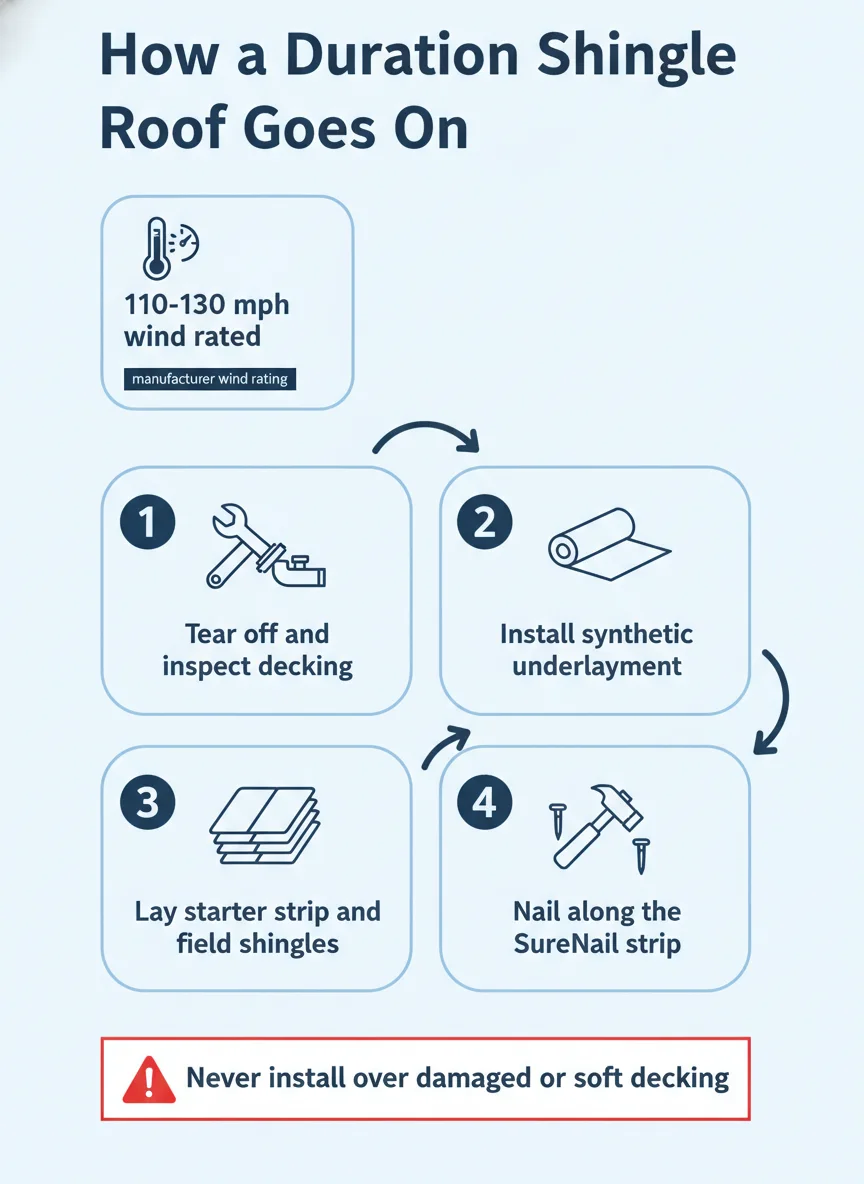
Owens Corning publishes wind resistance ratings for the Duration line in the 110 to 130 mph range, depending on the specific installation method used. Those numbers come from manufacturer testing under controlled conditions, and they assume correct fastening, proper deck prep, and code-compliant installation, which is part of why who installs the roof matters as much as which shingle goes on it.
Architectural shingles in this weight class also tend to perform better against hail impact than lighter three-tab shingles, simply because there's more material absorbing the strike. No asphalt shingle is hail-proof, but a heavier, reinforced shingle is less likely to bruise or crack from the kind of moderate hail Missouri sees most springs.
| Feature | Three-Tab Shingle | Owens Corning Duration |
|---|---|---|
| Construction | Single layer, lighter mat | Laminated, reinforced mat |
| Wind performance | Lower wind tolerance | Rated up to 130 mph by manufacturer |
| Appearance | Flat, uniform tabs | Dimensional, shadow-line look |
| Typical lifespan | Shorter service life | Longer service life with proper ventilation |
What's Actually in a Duration Shingle Roof System
The shingle itself is only one layer of the system. Underneath it sits a synthetic underlayment that acts as a secondary water barrier if wind-driven rain gets past the shingles. Along the eaves and in valleys, we add ice and water protection where it's needed most. A starter strip runs along the edges to lock the first course of shingles down against wind, and ridge cap shingles finish the roof line at the peak.
Each of those pieces is designed to work together as a manufacturer-tested system. Mixing an off-brand underlayment or a generic ridge cap with Duration field shingles can void portions of the manufacturer's warranty, which is one reason we keep the components consistent from the deck up.
Step-by-Step: How We Install Duration Shingles
A roof replacement with Duration shingles follows a fairly consistent sequence, whether the home is in Gladstone or anywhere else in the metro. Here's the general order our crews work through.
- Tear off old roofing: We remove the existing shingles down to bare decking so we can check for soft spots, rot, or damage that needs addressing first.
- Inspect and repair decking: Any damaged plywood or boards get replaced before anything new goes down, since a weak deck undermines everything installed on top of it.
- Install underlayment: A synthetic underlayment goes down across the full roof, with extra protection added at eaves and valleys where water collects.
- Set the starter strip: A starter course runs along the eaves and rakes to anchor the first row of field shingles against wind uplift.
- Lay the field shingles: Duration shingles go on course by course, nailed through the SureNail strip at the manufacturer's specified pattern and spacing.
- Finish ridge and vents: Ridge cap shingles and any vent flashing are installed last to seal the peak and keep attic ventilation working as designed.
- Final walkthrough: We walk the roof and the property to check the finished work and clear away debris before calling the job done.
What You'll Notice on the Roof Afterward
Curb Appeal and Color Options
Duration shingles have a dimensional, shadow-line look rather than the flat profile of a basic shingle, which tends to make a roof look thicker and more textured from the street. The line comes in a range of color blends, which gives homeowners more flexibility to match brick, siding, or trim than a single flat color option would.
Beyond looks, most homeowners notice the roof simply lays flatter and tighter along the ridge and valleys compared to older three-tab roofs, since the shingles are heavier and the nailing pattern locks them down more securely.
Performance Through Missouri Weather
The real test of any shingle in this region isn't the first year, it's how it holds up through repeated freeze-thaw cycles, summer UV exposure, and the occasional spring hailstorm. A properly installed Duration roof is built to stand up to that cycle for a multi-decade service life, with good attic ventilation playing a big role in how long the shingles actually last.
If a storm does cause damage, storm and hail damage repair on a Duration roof generally means replacing the affected shingles with matching material rather than redoing the whole roof, assuming the damage is localized.
What a Homeowner Can Do vs. What Needs a Licensed Roofer
There's very little about shingle installation itself that's a reasonable DIY project, even for a handy homeowner. Working on a roof deck involves fall risk, and getting the nailing pattern wrong on a shingle like Duration can quietly undercut the wind rating without any visible sign until the next big storm.
What a homeowner can do is stay informed: know what shingle is currently on the roof, ask a contractor what line they're proposing to install and why, and ask whether that installer carries a manufacturer certification for the product. That's a fair question to ask any roofer, not just us.
The parts that genuinely need a licensed, certified crew are the deck inspection, the underlayment system, and the actual fastening of the shingles. Those are the steps that determine whether the roof performs anywhere close to its published rating once real weather hits it, and they're worth getting right the first time rather than fixing later.
Choosing a Shingle That Matches the Region
A shingle line is only as good as the climate it's matched to and the crew installing it. For the wind, hail, and temperature swings common across the Kansas City metro, a heavier, laminated architectural shingle with a reinforced nailing strip is a reasonable standard to look for, whichever contractor you hire.
For more on what to watch for over the life of a roof, see Signs Your Roof Needs Attention. Signature Roofing installs Owens Corning Duration shingles on the roofs we replace, backed by our 10-year workmanship warranty.
Frequently asked questions
What shingle brand does Signature Roofing install?
We install Owens Corning Duration shingles, and we're a certified Owens Corning Preferred Contractor. We chose this line because it's built for the kind of wind and hail swings the Kansas City metro sees every spring.
Are Owens Corning Duration shingles rated for high wind?
Owens Corning publishes wind ratings in the 110 to 130 mph range for the Duration line, depending on the install method and local code requirements. A certified installer follows the manufacturer's nailing and fastening pattern to actually reach that rating, not just the shingle itself.
Do Duration shingles hold up to hail better than cheaper shingles?
Architectural shingles like Duration are generally heavier and more impact-resistant than basic three-tab shingles, because they use more asphalt and a reinforced mat. That doesn't make any shingle hailproof, but it does mean fewer bruised or cracked tabs after a moderate storm.
How long do Owens Corning Duration shingles last?
Architectural asphalt shingles in this class are typically built for a multi-decade service life, with performance depending heavily on attic ventilation, installation quality, and Missouri's freeze-thaw and UV exposure. Our workmanship on these roofs is backed by a 10-year warranty that transfers to the next owner if you sell.
Can you install a different shingle brand if I prefer one?
Our crews are set up and certified to install Owens Corning Duration shingles, which is the line we stand behind for the installs we do. Talk with us about your project and we'll walk through what fits your roof.