
Why age catches up with every roof eventually
Every asphalt shingle roof has a working lifespan, and homes across the Kansas City metro see the kind of weather swings that tend to use up that lifespan on the faster side. Hot, humid summers bake the asphalt and dry out its protective oils, while freezing winters and freeze-thaw cycles stress the material in the opposite direction. Over enough years, that back-and-forth takes a toll that shows up as curling edges, bald patches, and shingles that crack instead of flex.
None of this happens overnight, which is exactly why it's easy to miss. A roof that's aging out doesn't usually announce itself with a dramatic leak right away. It shows small, gradual signs first, and catching those signs early gives homeowners more say in the timeline instead of reacting to a leak during the next storm.
What's actually happening to the shingles
Three related changes tend to show up together as a shingle roof reaches the later part of its service life, and each one compounds the others.
Shingles reaching the end of their service life
Every shingle product is built to last a certain number of years under normal conditions, and once a roof passes that window, the asphalt itself starts to lose flexibility and structural soundness even if nothing looks dramatically wrong yet. This is the underlying cause behind most of the other symptoms on this list.
Knowing roughly when a roof was installed, or when the home was built if the original roof is still in place, gives a useful baseline for how much life is realistically left before other symptoms start piling up.
Granule loss exposing the shingle mat
Granules are the small protective particles embedded in the shingle surface that shield the asphalt layer from direct UV exposure. As a roof ages, these granules gradually wear away and wash into the gutters, which is often one of the first visible clues something's changing.
Once enough granules are gone, the exposed asphalt degrades noticeably faster than before, since it's now taking the full brunt of sun exposure directly. This is part of why granule loss tends to accelerate rather than stay steady once it starts.
| Sign | What It Suggests | Typical Stage |
|---|---|---|
| Curling edges on a few shingles | Localized aging or ventilation issue | Early, worth monitoring |
| Granules collecting in gutters | General wear across the roof | Mid-life, worth an inspection |
| Shingles crack underfoot or in cold weather | Material has become brittle | Later stage, replacement likely |
| Bald, shiny patches across large areas | Significant granule loss, UV exposure | Later stage, replacement likely |
Brittle shingles and what causes it
As asphalt shingles age, the oils that keep them flexible dry out, leaving the material stiffer and more prone to cracking under stress. This is why an older roof that seemed fine for years can suddenly show cracked shingles after a hailstorm or a bit of foot traffic from a technician working on a vent or an antenna.
Brittleness is also a safety consideration, since walking on a brittle roof risks cracking shingles that would otherwise have held up fine under normal conditions. It's one more reason this kind of assessment is better handled by someone experienced in reading how a roof is holding up structurally, not just visually.
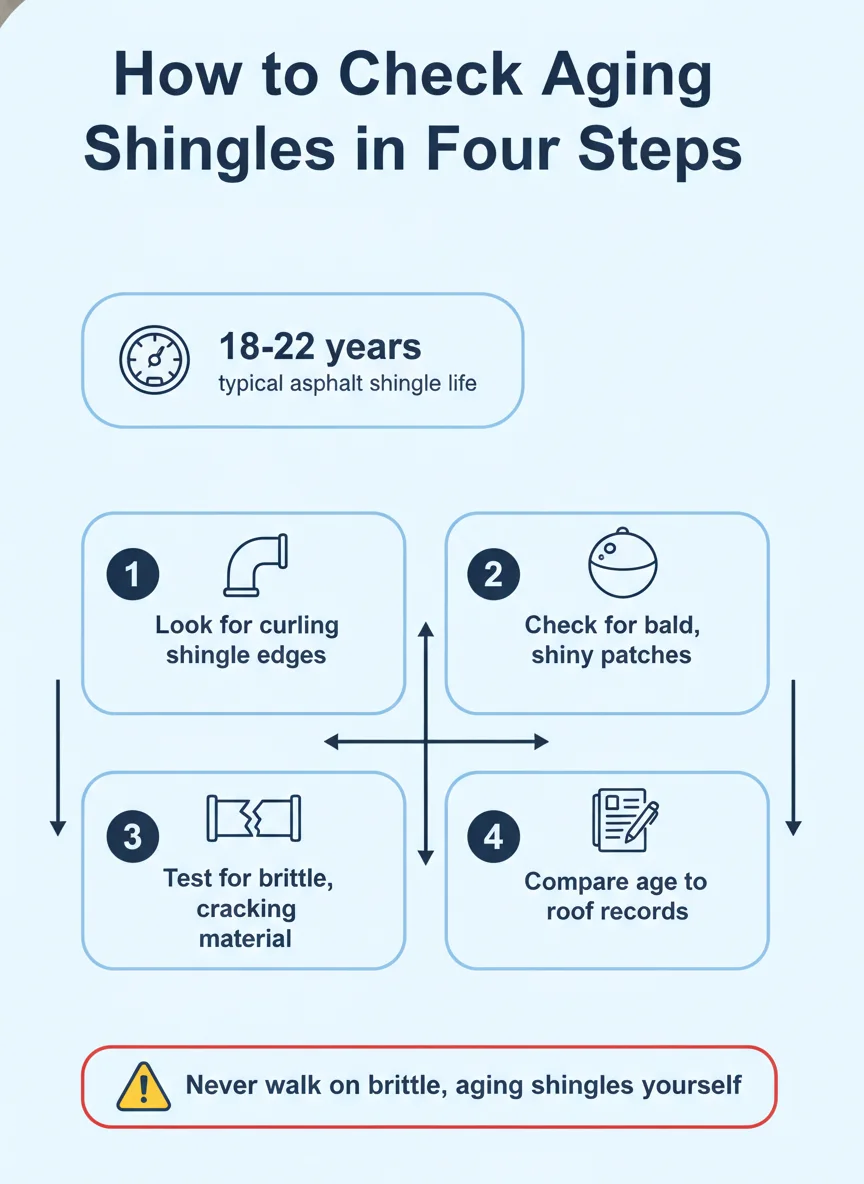
Step-by-step: what an aging roof inspection typically looks like
A standard inspection for an aging roof usually takes about an hour for a typical residential home.
- Visual walk of the surface: The roofer checks for curling, cracking, and granule loss across every section of the roof, not just the visible front slope.
- Gutter check: Granule buildup in the gutters is a quick indicator of how much wear the shingles have already accumulated.
- Flex and soundness test: Shingles get gently checked in a few spots for brittleness without unnecessary walking on fragile sections.
- Decking check: Soft spots underneath aging shingles can signal moisture has already reached the wood below.
- Remaining life estimate: You'll get a straightforward read on how many more seasons the roof likely has left before replacement makes more sense than repair.
What the inspection usually turns up
Once someone's actually up there, the findings generally split into two groups depending on how far along the aging process is.
Localized wear worth watching
If curling and granule loss are limited to one section, particularly one with poor ventilation or more direct sun exposure, it may be reasonable to monitor and address specific spots rather than replace the whole roof right away.
Roof-wide aging
When curling, brittleness, and granule loss show up consistently across the whole surface, that's a strong sign the roof is aging out as a system rather than in isolated spots, and roof replacement becomes the more practical long-term answer.
What you can check yourself versus what needs a professional
Checking gutters for granule buildup and looking at the roof from the ground with binoculars for obvious curling are both things a homeowner can reasonably do on their own. It's a good way to get a rough sense of where things stand between scheduled inspections.
Actually assessing brittleness, checking the decking underneath, and making a call on repair versus replacement takes someone experienced with reading how far along a roof's aging process really is. Two roofs that look similar from the ground can be in very different shape once someone's actually walking the surface.
This is also a case where a professional opinion protects you from either direction, replacing a roof too early that had life left, or patching one that really needed a full replacement. That judgment call is worth getting right.
Knowing where your roof stands
An aging roof rarely fails all at once. It gives off small signals for years before a real problem shows up, and reading those signals early is what keeps a homeowner in control of the timeline. For more on the general signs worth tracking, see signs your roof needs attention, and for a deeper look at typical lifespans in this climate, check how long does a roof last in Missouri.
If your roof in Liberty or elsewhere across the metro is showing curling, bald patches, or shingles that feel brittle underfoot, it's worth having someone take an honest look. Signature Roofing has spent over 20 years reading exactly these signs on roofs across the Kansas City area.
Frequently asked questions
How do I know if my shingles are curling because of age?
Curling typically appears as the shingle edges or corners lifting and turning upward instead of lying flat, and it usually shows up gradually across large sections of the roof rather than in one isolated spot. That widespread pattern is the main clue it's age-related rather than storm or installation damage.
What causes bald spots or granule loss on shingles?
Granules wear off gradually through decades of sun and weather exposure, and once enough are gone the asphalt underneath starts breaking down faster since it's no longer protected from UV rays. Finding granules building up in gutters is one of the more reliable early signs this is happening.
How long do asphalt shingles typically last in Missouri?
Asphalt shingles across the industry generally last somewhere in the range of 18 to 22 years depending on material quality, attic ventilation, and how much direct sun and weather exposure the roof gets. Missouri's swing between hot summers and freezing winters tends to push wear toward the shorter end of that range.
Can curling or bald shingles be repaired instead of replaced?
It depends on how widespread it is. A handful of curling shingles in one section can sometimes be replaced individually, but curling and granule loss spread across most of the roof usually signals the whole surface is aging out together, which points toward replacement instead of a patch.
What happens during an inspection of an aging roof?
A roofer typically walks the full roof surface checking for curling, cracking, granule loss, and soft spots in the decking, which usually takes about an hour for a standard residential roof. You'll get a straightforward read on how much service life is realistically left.