
Why Knowing Your Roof's Age Actually Matters
Homeowners across the Kansas City metro ask this more often than you'd think, usually right after they've gotten an insurance renewal notice or started thinking about selling. The roof is one of the few home systems that quietly ages in the background for years with no obvious signal, until a storm rolls through and you're left wondering whether what's up there is five years old or twenty-five.
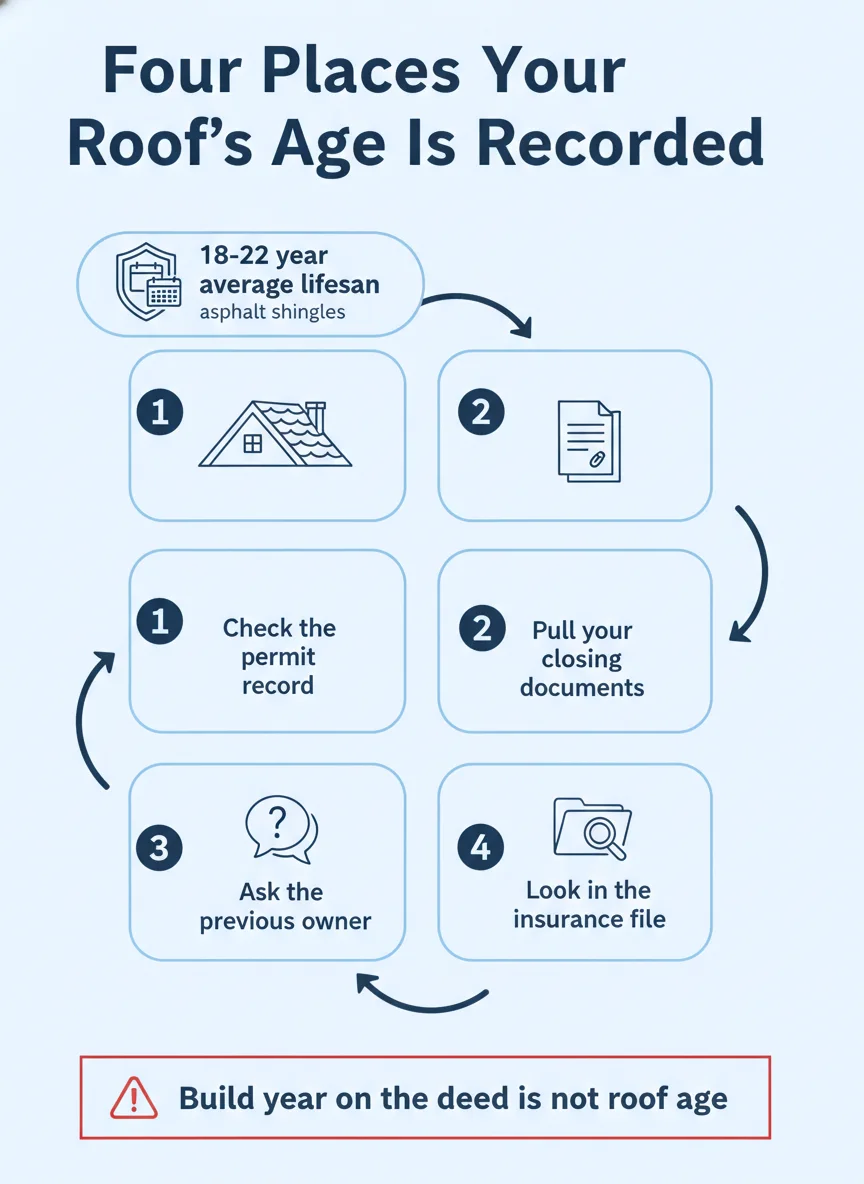
The build year of the house is the number people reach for first, and it's almost always the wrong number. Most homes have had at least one full roof replacement by the time they change hands, sometimes two or three, so the age tied to the deed and the age of the actual shingles over your head are two different facts. Tracking down the real one takes a little digging, but it's doable, and it matters for warranty claims, insurance underwriting, and knowing when to start budgeting for the next one.
Why the Build Year on Your Deed Isn't the Answer
County records show when a structure was built, not when its roof was last replaced. A roof's lifespan runs well short of a home's, so by the time a house is thirty or forty years old it has almost certainly had the covering redone at least once, and the county record never updates to reflect that.
Additions, Remodels, and Partial Replacements
Homes with additions or major remodels often end up with mismatched roof ages across different sections. A kitchen bump-out or a converted garage might carry a newer section of roof than the original structure, which means one house can genuinely have two different roof ages depending on which part you're standing under.
This is worth checking before you assume the whole roof is one age. Walk the property and look for a visible seam where materials or shingle color shift, which usually marks where an addition was tied into the original roofline.
Previous Owners Who Did Their Own Repairs
A prior owner who patched a section themselves, or had a smaller repair done without a full permit, leaves no official trail at all. These informal fixes are common on older homes and are one of the main reasons the permit record alone doesn't always tell the complete story.
In those cases, a visual inspection becomes more valuable than any document, because it's reading the actual material rather than a paper trail that may have gaps.
| Record Source | What It Tells You | How Easy to Get |
|---|---|---|
| Building permit | Dated record of a full replacement | Public record, request from city or county |
| Closing paperwork | Seller's disclosed age or install year | Check your own file from the home purchase |
| Previous owner invoice | Exact install date and installer | Ask the prior owner or their agent directly |
| Insurance file | Age noted at underwriting or last claim | Call your insurance agent or carrier |
What's Actually Recorded When a Roof Goes On
A full roof replacement in most Missouri jurisdictions requires a building permit before work starts and a final inspection sign-off when it's done. That permit gets logged with a completion date, the scope of work, and sometimes the materials used, which is exactly the kind of dated, verifiable record a homeowner needs.
What doesn't always get recorded is a repair, a tarp job, or a partial section replacement, since many of those fall under a threshold that doesn't trigger a permit requirement. That's part of why a thorough roof repair history can be harder to trace than a full roof replacement, which almost always leaves a paper trail.
Step-by-step: Tracking Down Your Roof's Age
Work through these in order. Most homeowners find an answer within the first two or three steps without needing to climb a ladder.
- Pull your closing file: Look through your home purchase paperwork for a seller's disclosure, which often lists the approximate age of major systems including the roof.
- Contact the building department: Call or search online for your city or county's permit records using your address to see if a roofing permit was filed and when it closed.
- Reach out to the previous owner: If you can track them down through your real estate agent, ask directly whether they replaced the roof and if they kept the invoice.
- Check your insurance file: Your current or past carrier may have the roof's age noted from when the policy was underwritten or from a prior claim.
- Look for a manufacturer warranty card: A registered shingle warranty, if one exists, usually has the install date tied to it in the manufacturer's system.
- Get a visual read from a roofer: If the paper trail dries up, a trained eye can narrow the age down by examining granule wear, curling, and material brittleness.
What the Visible Signs Can Tell You
When documents aren't available, the shingles themselves hold clues. None of these signs give you an exact year, but together they narrow the range enough to make a reasonable estimate and decide whether it's worth pursuing records further.
Granule Loss and Curling Edges
Asphalt shingles shed granules as they age, and you'll often see the gritty residue collecting in gutters or at downspout outlets before you notice it on the roof itself. Heavy, consistent granule loss across the whole roof usually points toward the back half of a shingle's service life rather than the front.
Curling at the edges or corners, sometimes called clawing, is another late-stage sign. Shingles that lie flat and tight generally indicate a newer roof, while widespread curling suggests the material has been through enough heat and cold cycles to start losing flexibility.
Attic Clues Worth Checking
From inside the attic, daylight showing through the roof deck, water staining on the underside of the sheathing, or sagging between rafters can all point to an aging or previously damaged roof. These signs don't date the roof precisely, but they do flag whether age has already started affecting performance.
If you find nail patterns that look doubled up, with two layers of shingles rather than one, that's a sign of a roof-over rather than a full tear-off, which can affect both the roof's remaining lifespan and what a future replacement will involve.
Finding the Paper Trail Yourself vs Calling a Pro
Most of the records search is something any homeowner can do without help. Pulling your closing documents, searching your county's permit database, and calling your insurance agent are all things you can knock out in an afternoon with a phone and an internet connection.
Where it helps to bring in a professional is the visual read, especially if the paper trail comes back empty or contradicts itself. A roofer who looks at shingles every day can spot the difference between cosmetic wear and a roof that's genuinely near the end of its service life, which isn't always obvious to an untrained eye from the ground.
It's also worth having a professional look if you're planning to sell, since buyers and their inspectors will ask the same age question you're asking now. Having a documented answer, rather than a guess, makes that conversation go a lot smoother on both sides.
Putting the Pieces Together
Finding your roof's age usually isn't a single lookup, it's a short process of checking a few records and reading a few signs until the picture is clear. Start with the documents, since they're the fastest path to a real answer, and use the visual signs to fill in the gaps when the paperwork doesn't exist.
Once you know roughly where your roof sits in its lifespan, it's easier to plan ahead instead of reacting to a leak, and it's useful context if you ever need Storm & Hail Damage Repair or want to compare notes with neighbors in Overland Park or elsewhere in the metro. For more on how long these roofs typically last once installed, see How Long Does a Roof Last in Missouri?, and if you'd rather skip the guesswork entirely, Signature Roofing can take a look and help you get a straight answer.
Frequently asked questions
Does the year my house was built tell me how old my roof is?
No, not reliably. A roof usually gets replaced at least once, sometimes twice, over the life of a home, so the construction year on your deed or county record almost never matches the age of the shingles currently over your head.
Where is a roof replacement usually recorded?
Most roof replacements require a building permit, and that permit is filed with the city or county building department along with the date the work was completed. It's often the single most reliable record because it's dated and public.
What if I can't find a permit for my roof?
Check your closing paperwork first, since a seller's disclosure often lists the approximate age or install date of major systems including the roof. If that's a dead end, the previous owner or their real estate agent may still have the original invoice.
Can a roofer tell how old a roof is just by looking at it?
An experienced eye can usually narrow it down by reading granule loss, shingle curl, and how brittle the material feels, but that gives a range, not an exact date. Pairing a visual read with a paper record is the most accurate approach.
Why does it matter if I know the exact age of my roof?
Age affects warranty coverage, insurance decisions, and how urgently you should plan for replacement, since most asphalt shingle roofs in this region run an 18 to 22 year lifespan. Knowing where you fall in that window helps you budget instead of getting surprised by a leak.