
A Common Question for Older Missouri Homes
Across the Kansas City metro, homeowners call us every year asking the same thing: is this worth repairing, or is it time to replace the whole roof? It's a fair question, and the answer isn't always obvious from the ground. A roof can look fine from the driveway and still be failing underneath, or it can look rough on the surface and still have plenty of life left.
The region's weather swings play a role here. Missouri roofs deal with freeze-thaw cycles in winter, strong spring storms, and long stretches of summer sun, all of which wear on shingles differently than a milder climate would. Knowing which signs point to a simple fix and which point to the end of the roof's service life can save a homeowner from spending money twice.
Why Roofs Eventually Move Past the Point of Repair
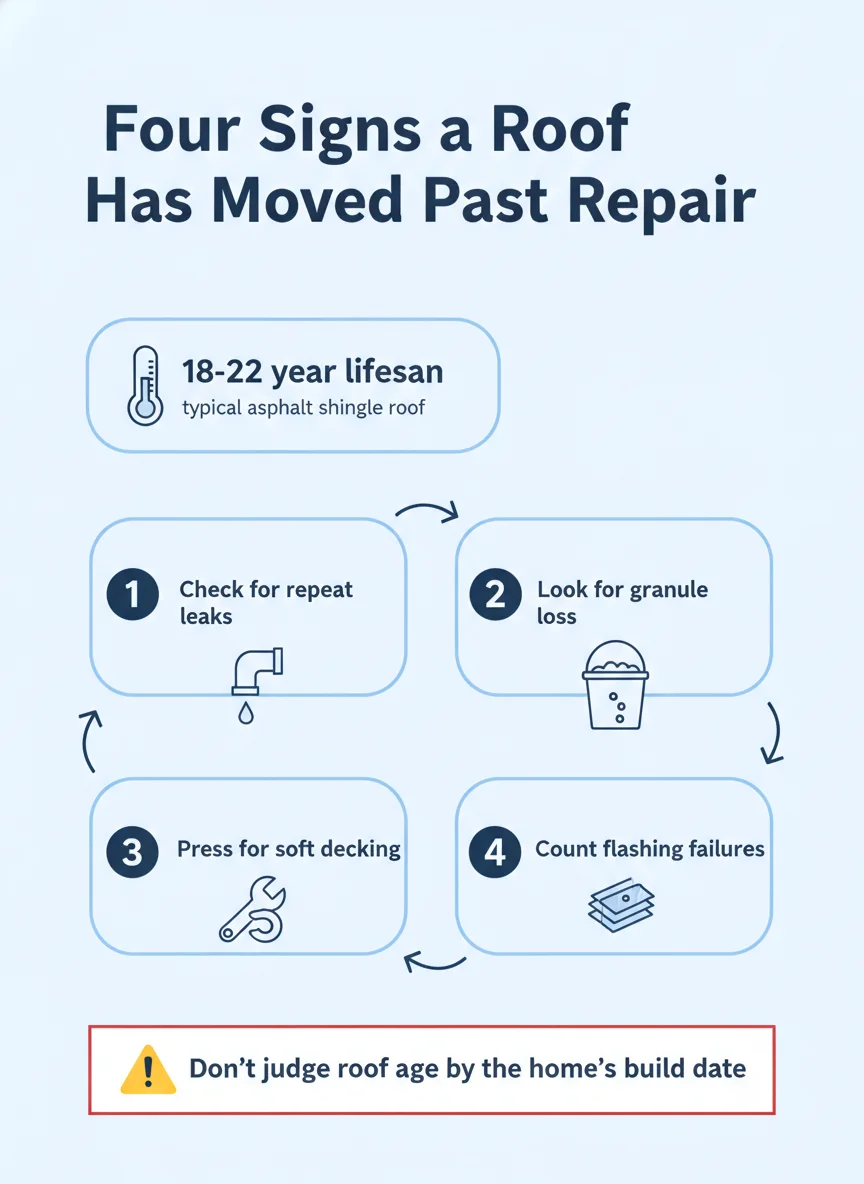
Every roofing material has a working lifespan, and asphalt shingles in this climate typically last somewhere in the range of 18 to 22 years across the industry. As a roof approaches that range, the materials themselves lose flexibility and granule coverage, which is what actually protects the shingle from UV and water. Once that protective layer is gone in enough places, a repair just delays the same failure somewhere else on the roof.
It's Not About the House's Age
One of the most common mix-ups homeowners run into is assuming the roof is as old as the house. That's rarely true. Roofs get replaced, patched, or layered over at different points across a home's life, sometimes by a previous owner with no record left behind.
The only reliable way to know a roof's real age is through past permits, a seller's disclosure, or a hands-on look by someone who can read the wear patterns. A 1960s house can have a roof that's five years old, and a newer build can have an original roof pushing past its expected service life.
What Repeated Problems Usually Mean
A single leak after a bad storm doesn't necessarily mean the roof is done. But a pattern of leaks showing up in different rooms over a couple of years usually means the roof's materials are failing broadly, not just at one weak spot. Each repair fixes the leak you can see, while the rest of the aging roof keeps moving toward the same outcome.
That's the core idea behind weighing roof repair against roof replacement: a repair fixes a point problem, while replacement addresses a roof that's failing as a whole system.
| Sign | Usually Still Repairable | Usually Points to Replacement |
|---|---|---|
| Leak location | One leak, isolated to a single spot | Leaks in multiple rooms over time |
| Granule loss | Light wear in one or two areas | Bald patches across large sections |
| Decking condition | Firm when walked or pressed | Soft or spongy in more than one spot |
| Flashing | One flashing point failing | Several flashing points failing at once |
The Parts of the Roof That Tell the Real Story
A roof is a system, not just the shingles you see from the street. Underneath the shingles sits the decking, the wood layer that everything is fastened to, and around chimneys, vents, and skylights sits flashing, the metal that seals those transition points. Both of these matter as much as the shingles themselves when deciding whether a roof can still be repaired.
Decking that's absorbed water over time loses its structural integrity, and flashing that's failed in multiple spots means water has likely been finding its way in longer than anyone realized. A roofer checking for repair versus replacement is really checking the condition of this whole system, not just counting missing shingles.
Step-by-Step: How a Roofer Evaluates Whether a Roof Can Be Repaired
Here's the general process a roofing professional walks through when assessing an older or storm-affected roof, from the surface down to the structure underneath.
- Walk the surface: The roofer checks for granule loss, curling shingles, and how brittle the material feels underfoot across the whole roof, not just one section.
- Check every leak point: Past and current leak locations get mapped out to see whether damage is isolated or spread across different parts of the roof.
- Press the decking: Soft spots in the decking get tested by walking and light pressure, since spongy decking signals moisture has already gotten in.
- Inspect all flashing: Every chimney, vent, and skylight gets checked individually, since one failed flashing point can be fixed but several usually can't be isolated.
- Look for a prior layover: If shingles were installed over an existing layer in the past, that roof has less structural room for another simple repair.
- Weigh age against condition: The roofer compares how old the materials appear to be against how much life is typically left in that type of roofing.
- Give a clear recommendation: The homeowner gets a straightforward read on whether a repair will realistically hold or whether replacement is the more sound choice.
What You'll Typically Find on an Older Roof
Roofs With a Prior Layover
Some roofs have shingles installed directly over an older layer instead of a full tear-off. This is a common shortcut, and it means there's already a second layer of material and nails on the roof deck. When a roof with a layover starts failing, there's usually no room to repair it in place, since the deck is already carrying two layers of roofing material.
If you're not sure whether your roof has a layover, a professional can usually tell by checking the edge of the roofline or looking at the attic from inside. It's worth knowing before any repair work starts, since it changes what's actually possible.
Roofs With Multiple Active Problem Areas
A roof with one bad flashing point, a little granule loss near the ridge, and a leak in the garage might look like three separate small problems. In practice, when these show up together on an older roof, they're usually symptoms of the same underlying material fatigue. Fixing each one individually tends to buy a year or two at most before something else surfaces nearby.
This is the pattern that most often tips the decision toward replacement. If you're seeing storm-related damage specifically, our guide on missing shingles after a windstorm covers how that scenario is typically assessed.
What a Homeowner Can Check vs What Needs a Licensed Roofer
From the ground, a homeowner can often spot some early warning signs without climbing up: shingles that look curled or cupped, bald spots visible with binoculars, granules collecting in gutters or downspouts, and daylight or water stains in the attic. These are worth noting and can help you describe the problem accurately when you call a professional.
What a homeowner generally can't safely check is decking firmness, the full condition of flashing around every penetration, or how widespread granule loss is across the whole roof plane. Walking a roof safely and reading these signs accurately takes experience, the right footing, and knowing what normal wear looks like versus wear that's crossed the line.
That's really the value a licensed roofer brings to this decision: an outside opinion based on what the materials and structure are actually doing, not just what's visible from the yard. A short on-site look usually settles the question faster than guessing from the ground.
Making the Call on an Older Roof
Deciding between one more repair and a full replacement comes down to pattern recognition: is this one isolated issue on a roof that's otherwise sound, or is it one more symptom on a roof that's been aging the same way everywhere at once? Age, repeat leaks, granule loss, soft decking, and flashing failures in multiple spots are the signals that tend to answer that question clearly.
If you're seeing more than one of these signs on your home, it's worth getting a straightforward read before spending money on a repair that may not hold. Signature Roofing has served the Kansas City metro for over 20 years and can help you sort out which side of that line your roof is on.
Frequently asked questions
How do I know if my roof is too old to repair?
A roof is usually too old to repair once it's showing granule loss across large sections, has had more than one or two leaks in different spots, or is nearing the upper end of its expected lifespan. One isolated issue on an otherwise sound roof is usually still a repair, but several of these signs together point toward replacement.
Does the age of my house tell me the age of my roof?
No, the age of the house does not tell you the age of the roof. Roofs get replaced, repaired, or layered over at different points in a home's life, so the only reliable way to know your roof's real age is past service records or a professional inspection.
What does soft decking mean and why does it matter?
Soft decking means the wood sheathing under the shingles has absorbed moisture and started to weaken, and it matters because shingles can't be reliably fastened to decking that gives underfoot. Once decking is soft in more than a small area, repair generally isn't enough and replacement becomes the safer path.
Can a roof with multiple leaks still be repaired?
Sometimes, but repeat leaks in different parts of the roof usually signal the underlying materials are wearing out everywhere, not just at the leak points. A few isolated leaks on a newer roof are often fixable, but recurring leaks on an older roof are a strong signal to consider full replacement.
Is it cheaper to keep repairing a roof than to replace it?
It depends on how often repairs are needed and how widespread the wear is. A roof needing frequent repairs in different areas often ends up costing more over a few years than one replacement would, since each repair only fixes that one spot while the rest of the roof keeps aging.