
Wind Damage Looks Minor From the Ground
A fast-moving line of storms rolls through the Kansas City metro most springs, and it doesn't take a tornado to strip shingles off a roof. Straight-line winds in the 50 to 70 mph range are enough to catch a weakened edge and peel it back, and homeowners from Riverside to Liberty often spot the aftermath the same way: a shingle or two sitting in the yard, or a gap visible from the street.
The instinct is to assume it's a small fix, patch the bald spot and move on. Sometimes that's exactly right. But a windstorm rarely damages only the shingles that actually came off. It stresses everything around them, and that's the part that's hard to judge standing on the ground.
Why a Few Missing Shingles Can Mean Many Broken Seals
Every asphalt shingle has a factory-applied seal strip, a band of adhesive that bonds it to the shingle course below once it's warmed by the sun after installation. That bond is what keeps shingles flat against the roof in normal wind. When a gust gets strong enough to break that seal, the shingle starts to flutter, and repeated flutter is what eventually tears it loose or cracks it at the nail line.
What the wind does on its way through
A storm doesn't hit a roof evenly. Wind accelerates around ridges, hips, and the edges of the roof plane, which is why damage often clusters along one side of a house rather than spreading evenly across the whole surface. The shingles that came off were simply the ones that lost their seal first, not necessarily the only ones that were stressed.
Neighboring shingles can be left with a broken or partially broken seal and still look fine. They're creased, lifted at the corner, or just loose enough that the next wind event finishes the job. That's the gap between what a homeowner sees from the yard and what Roof Repair crews check for during an inspection.
Age changes how much damage a storm causes
A roof that's a few years old usually has flexible, well-sealed shingles that shrug off anything short of a severe event. An older roof, where the asphalt has started to dry out and the seal strips have lost some of their tack, loses shingles far more easily in the same wind speed. That's part of why two houses on the same block can come through identical weather with very different results.
This is also why a roofer's first question after a storm call is usually about the roof's age and history, not just the storm itself. A 6-year-old roof with four missing shingles is a different conversation than a 20-year-old roof with the same four missing shingles.
| Sign | Usually a repair | Usually points to replacement |
|---|---|---|
| Missing shingles | A handful, isolated to one area | Scattered across multiple slopes |
| Surrounding shingles | Still flat and sealed | Several lifted, cracked, or brittle |
| Roof age | Newer roof, good overall condition | Already near the end of its service life |
| Decking underneath | Dry, solid | Soft spots or visible staining |
What's Actually Under a Missing Shingle
Underneath every shingle course sits an underlayment layer, a water-resistant barrier nailed directly to the roof deck. It's built to handle short-term exposure, not to be a permanent roof surface. When shingles blow off, the underlayment is doing the job alone, and if it's an older or already-worn section, it may not hold up through a heavy rain.
Below that is the roof deck itself, typically plywood or OSB sheathing nailed to the rafters. This is the layer that actually keeps water out of the attic, and it's also the layer most vulnerable to long-term damage if moisture gets past the underlayment repeatedly. A roofer checking storm damage is really checking three layers, not just the shingles you can see from below.
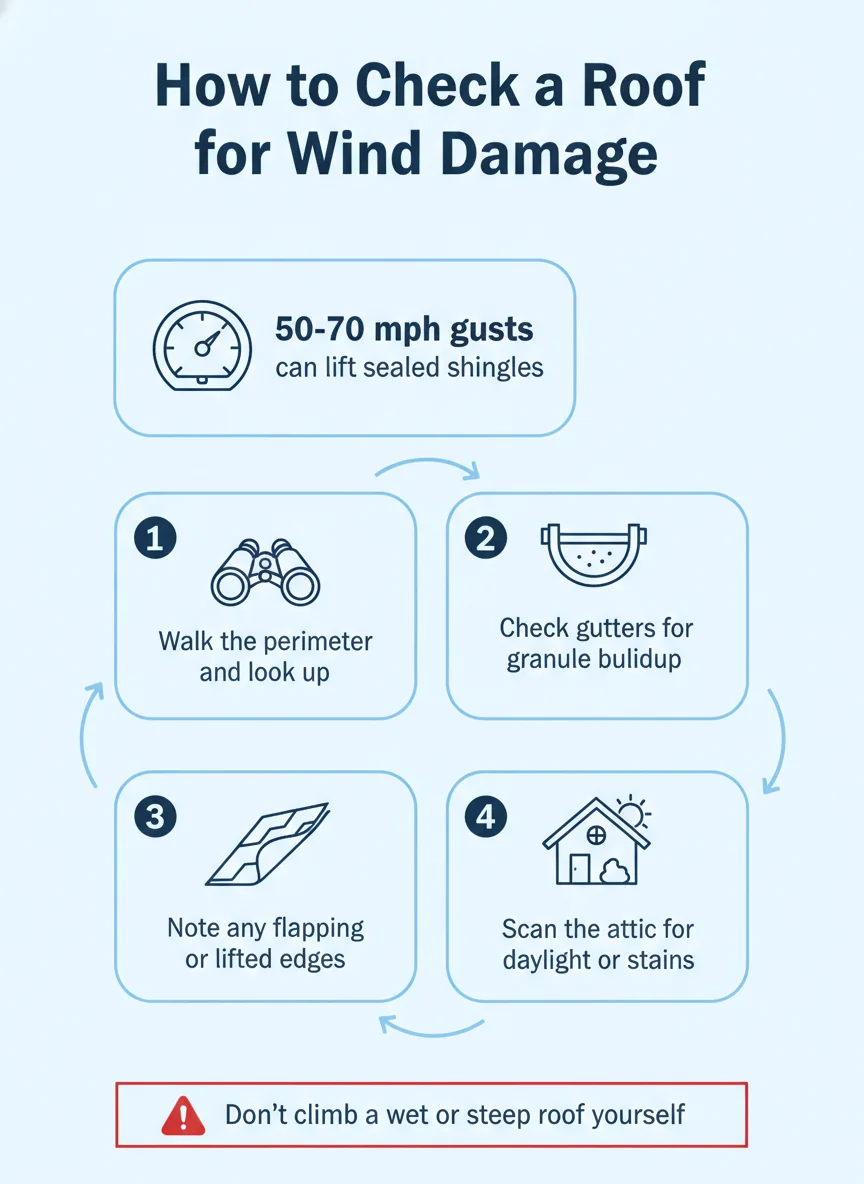
Step-by-step: How a Roofer Evaluates Wind Damage
A thorough wind-damage check moves from the ground up to the attic, and it's worth knowing what each step is actually looking for before you schedule one.
- Ground-level walk: The roofer walks the perimeter of the house checking for shingles, granules, or flashing pieces in the yard and gutters.
- Visual roof scan: From a ladder or the roof itself, they look for lifted edges, creased shingles, and exposed nail heads around the missing area.
- Seal strip check: Shingles near the damage are checked by hand to see if they're still bonded or just resting in place.
- Decking inspection: Where shingles are gone, the exposed decking is checked for soft spots, discoloration, or moisture.
- Attic check: From inside the attic, the roofer looks for daylight, water stains, or damp insulation below the damaged area.
- Full-roof comparison: The damaged section is compared against the rest of the roof's age and condition to see if it's an isolated event or a sign of broader wear.
What the Inspection Usually Turns Up
When it's an isolated repair
If the roof is relatively young and the damage is confined to one section, a roofer can typically strip the affected area down to solid decking, replace any damaged underlayment, and install new shingles tied into the existing courses. Matching is easiest on a roof that's only a few years old, since the color hasn't faded much from sun exposure yet.
This is the outcome most homeowners hope for, and it's a realistic one when the rest of the roof tested sound during the inspection. A good contractor will show you the areas they checked, not just the spot that's obviously missing shingles.
When it points toward replacement
If the inspection turns up multiple weakened seal strips, soft decking, or shingles that are visibly brittle across more than the damaged section, patching that one area doesn't solve the underlying problem. The roof already lost its wind resistance in several places, and the storm just happened to finish the job on a few of them first.
In that situation, a Roof Replacement addresses the whole surface at once rather than leaving a roof that's likely to shed more shingles in the next windstorm. It's also usually the point where filing a claim through your homeowner's policy becomes part of the conversation, since storm damage across a wider area is treated differently than a single localized repair.
What a Homeowner Can Check, and What Needs a Pro
You can safely do a ground-level check yourself after a windstorm. Walk the yard and driveway for shingles or granules, look at the gutters for a buildup of dark grit, and glance up at the roofline from a safe distance for anything obviously out of place. If you have attic access, a quick look for daylight coming through the roof deck or fresh water stains is useful information to pass along to a roofer.
What you shouldn't do is get on a ladder to inspect the roof surface itself, especially after a storm when shingles may be loose and decking may be wet. Checking seal strips, probing decking for soft spots, and evaluating the roof as a whole against its age and history takes training and the right equipment to do safely.
That's also the point where insurance documentation matters. A licensed roofer knows how to photograph and describe wind damage in a way that supports a claim, which is harder to do well after the fact if the damage has already been patched or covered. If you're unsure whether your policy applies, Insurance Claim Assistance is worth asking about before any repair work starts.
Getting the Right Call the First Time
Missing shingles are easy to notice and easy to underestimate. The real question isn't how many shingles are gone, it's what condition the roof around them is in, and that's not something you can judge accurately from the driveway. A roof that's a few years old with isolated damage is usually a straightforward repair. An older roof with the same missing shingles is often telling you it's done holding its seal in strong wind.
If a storm has left your roof in Riverside, Kansas City, or anywhere else in the metro with missing or lifted shingles, it's worth getting a second set of eyes on the rest of the roof too, not just the obvious gap. For more on how roofers weigh these calls in general, see Repair or Replace: How Roofers Actually Make the Call. Signature Roofing has handled this exact call for Kansas City metro homeowners for over 20 years.
Frequently asked questions
Why does wind pull shingles off instead of just bending them?
Wind gets underneath a shingle's edge and works against the seal strip that glues it to the shingle below. Once that seal breaks, the shingle has nothing holding it flat, so the next gust can lift it, crease it, or tear it off completely.
If only three or four shingles are missing, do I really need more than a quick patch?
Often, yes, because wind rarely damages just the shingles you can see. A roofer checks the surrounding seal strips too, since a gust strong enough to remove one shingle usually broke several nearby seals that haven't failed yet.
Can a roofer match new shingles to an older roof?
It depends on how long the current shingles have been on the roof. Sun exposure fades asphalt shingles over time, so a patch with brand new shingles can stand out even when the material itself matches, which is something to weigh when deciding between a repair and a wider replacement.
What happens if I leave missing shingles unrepaired?
The exposed roof deck underneath has no protection from rain, so water can work into the plywood and the attic insulation below it. What starts as a cosmetic gap can turn into rot, mold, or a ceiling stain within a single wet season.
How soon after a windstorm should I have the roof looked at?
As soon as it's safe to do so, ideally within a few days. Getting ahead of it matters more when rain is in the forecast, since every storm after the first one pushes more water through an already-open spot.