
Why This Decision Matters for Homes Across the Kansas City Metro
Asphalt shingle roofs across Missouri go through a lot: freeze-thaw cycles in winter, UV exposure all summer, and wind and hail that roll through on a regular basis. By the time a roof is old enough to need full replacement, the decking, flashing, and ventilation underneath have usually been through a couple decades of that cycle too, not just the shingles on top.
That's why the roof-over versus tear-off question comes up at replacement time, not repair time. Homeowners across Kansas City and the surrounding metro often get quoted both options, and the lower price on a layover can look appealing. The decision affects more than this install, it affects how the next 20 to 30 years of shingle life actually play out.
What Actually Happens Under a Second Layer
A roof-over means new shingles get nailed directly on top of the existing layer, with no removal of what's already there. A tear-off strips every layer down to bare decking before anything new goes on. The difference isn't just labor, it's whether anyone ever actually looks at what's underneath that top layer of shingles before sealing it in for another couple decades.
What a Layover Hides
With a roof-over, the decking stays covered the entire time. Soft spots, water staining, or rot from a slow leak never get seen or addressed, they just get another layer of shingles nailed over the top. The same goes for flashing around chimneys, vents, and skylights, which often needs attention by the time a roof is old enough for replacement.
Ventilation is the other thing a layover leaves alone. If the attic isn't venting properly, adding a second shingle layer doesn't fix that, it just adds more material sitting on top of a roof system that's already struggling to release heat and moisture the way it should.
What a Tear-Off Reveals
Stripping the roof down to decking gives a roofing crew a direct look at the plywood or OSB underneath. Any soft, delaminated, or water-damaged sections get identified and replaced before new material goes down, instead of getting buried under fresh shingles and discovered later as an active leak.
A tear-off also means flashing around every penetration gets reset with the new system, not patched around an old layer. That matters most at chimneys, skylights, and vent pipes, which is where most roof leaks actually start regardless of how old the shingle field itself is.
| Factor | Roof-Over | Tear-Off |
|---|---|---|
| Decking inspection | Not possible, stays covered | Fully exposed and checked |
| Added weight | Second layer adds load to structure | Single layer, no stacked weight |
| Manufacturer warranty | Often reduced or excluded | Typically full coverage eligible |
| Code allowance | Usually capped at one layover | Always allowed, no layer limit |
Weight, Heat, and the Manufacturer Warranty
Every layer of shingles adds weight to the roof structure, and a second layer means the rafters and decking are carrying double the shingle load they were built for. Most homes handle one extra layer fine, but it's additional stress on framing that was never part of the original design calculation, especially once snow or ice adds its own weight on top.
Heat is the other factor. A second layer traps more heat against the decking in summer, which can shorten the life of the new shingles sitting on top of it. And because many manufacturers reduce warranty terms for shingles installed over an existing layer, a Roof Replacement done as a tear-off is usually the version that keeps full warranty coverage intact.
Step-by-Step: How a Full Tear-Off Replacement Happens
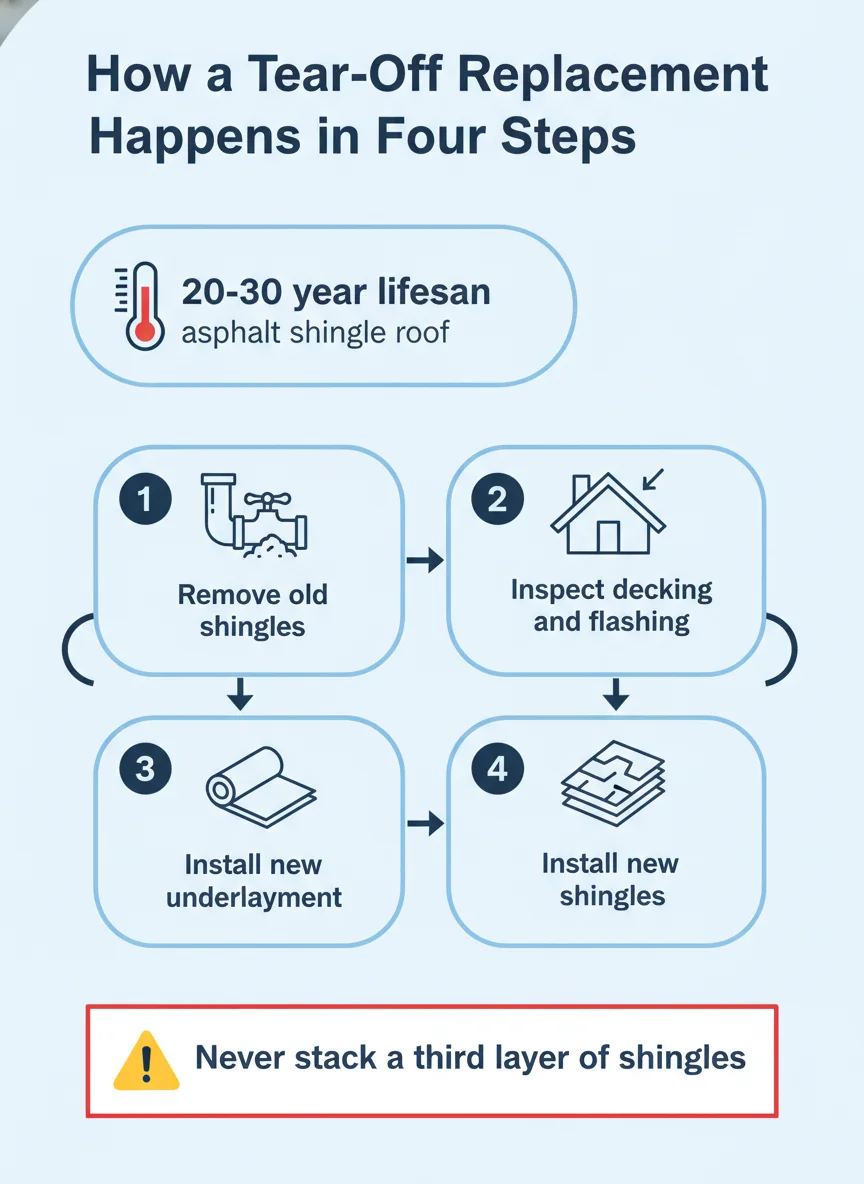
A tear-off follows a consistent sequence regardless of the home. Here's the general order most roofing crews follow from start to finish.
- Protect the property: Tarps and plywood go down around landscaping, siding, and anywhere falling debris could cause damage during removal.
- Strip old shingles: Every layer of existing shingles and underlayment comes off down to bare decking, typically in one day for most residential roofs.
- Inspect the decking: The crew checks every section of plywood or OSB for soft spots, rot, or water damage and replaces anything that doesn't pass.
- Replace flashing: New flashing goes in around chimneys, vents, and skylights so every penetration point ties into the new roofing system properly.
- Install underlayment: A fresh moisture barrier goes down across the entire deck before any shingles are installed.
- Install new shingles: Shingles go on in a single, properly fastened layer, matched to the home's pitch and local wind exposure.
- Final cleanup and walkthrough: Debris and nails are cleared from the property and the finished roof is reviewed with the homeowner.
What a Tear-Off Usually Uncovers
Decking Problems
It's common for a tear-off to reveal a handful of decking sections that need replacing, especially around valleys, chimneys, and lower edges where water tends to sit longest. These areas take the most exposure over the life of a roof and are the first places moisture finds a way in if a seal has failed.
Finding this during a tear-off means it gets fixed before new shingles go down. Finding it later, after a layover sealed it in, usually means a leak and interior damage first, which costs more to address than catching it during the replacement itself.
Ventilation Gaps
A full tear-off is also the natural point to correct attic ventilation that isn't performing the way it should. Ridge vents, soffit vents, and exhaust vents all get evaluated and can be adjusted or added while the roof deck is already exposed.
Proper ventilation affects how long the new shingles last, since trapped heat and moisture in the attic are two of the biggest factors that shorten shingle life regardless of the brand or quality installed on top.
Is This a DIY Decision or a Pro Call?
Deciding between a roof-over and a tear-off isn't something a homeowner can accurately judge from the ground or even from the attic. It requires someone on the roof checking the condition of the existing shingles, the decking underneath where accessible, and the flashing at every penetration point.
Licensing and local code also come into play, since many jurisdictions limit how many layers a roof can carry and require permits for replacement work regardless of which method is used. A licensed roofing contractor knows what your local building department requires before work starts, not after.
What a homeowner can do is ask the right questions before signing a contract: how many layers are currently on the roof, what the decking inspection process looks like, and whether the shingle manufacturer's warranty terms differ between a layover and a tear-off. Those answers tell you a lot about which option actually makes sense for your home.
Making the Right Call for Your Roof
A roof-over can be a reasonable, lower-cost option in limited situations, typically when the existing layer is still in good shape, the decking was recently inspected, and local code allows it. Outside of those conditions, most roofing professionals recommend a tear-off because it's the only way to actually know what's happening under the surface before closing it back up for another couple decades.
If you're weighing the two options for your own home, it helps to first understand how long a roof is expected to last in this climate; our post on How Long Does a Roof Last in Missouri? covers that in more detail. Signature Roofing walks homeowners through both options honestly, including what a tear-off is likely to uncover before any work begins.
Frequently asked questions
Is a roof-over cheaper than a tear-off?
A layover typically costs less upfront because it skips the labor and disposal of removing the old shingles. That savings can disappear fast if the old layer was hiding rot, a leak, or a flashing problem that now gets sealed in instead of fixed.
Can you put a new roof over an old one in Missouri?
In many cases yes, as long as the existing layer is in reasonable shape and local code allows it, but most building departments cap it at one existing layer. Your roofing contractor can tell you what your jurisdiction allows and whether your roof qualifies.
How many layers of shingles can be on a roof?
Most building codes limit roofs to two total layers of asphalt shingles, meaning only one layover is typically allowed before a tear-off becomes mandatory. Older homes that already have two layers usually have no choice but a full tear-off at replacement time.
Does a roof-over void the manufacturer warranty?
Many shingle manufacturers reduce or exclude warranty coverage when shingles are installed over an existing layer instead of bare decking. Reading the fine print on the specific product being installed is the only way to know for sure before work starts.
Why do roofers usually recommend tear-off over roof-over?
A tear-off lets your contractor see and fix what's actually happening at the decking, flashing, and ventilation, not just what's visible from the old shingle surface. It also resets the roof to a single, properly fastened layer instead of adding weight and trapped heat on top of what's already there.